Thursday, August 28, 2008

What We Really Own


"Only that which cannot be lost in a shipwreck is yours."
- Imam al-Ghazzali

"He tried"

From Haaretz.com

Israeli peace pioneer Abie Nathan dies aged 81
Abie Nathan - By The Associated Press

Israeli peace pioneer, pirate radio station founder and former Royal Air Force pilot - has died in Tel Aviv at the age of 81, officials at the city's Ichilov Hospital said Wednesday.

Nathan burst onto the world of Middle East diplomacy in 1966 with a dramatic solo flight to Egypt in a rattletrap single-engine plane, more than a decade before Israel and Egypt signed a peace treaty.

Although he failed in his initial bid to talk peace with the Egyptians, his daredevil escapade won the affection of many Israelis, and he launched a long and often eccentric one-man crusade to end the Arab-Israeli conflict.

Over time, he earned a reputation as a maverick peace activist who often took diplomacy into his own hands. He was called a crackpot and a prophet. But many admired the daring of the former Israel Air Force fighter pilot as he pounded on Egypt's doors, sailed his pirate radio ship into hostile Middle East waters or risked his life on hunger strikes for peace.

Yossi Sarid, the former leader of the leftist Meretz party, said Nathan paved the way for Israel's peace movement. "He was ahead of his time, and he did everything himself," he said.

Abraham Jacob Nathan was born April 29, 1927 in Iran, educated in India, and served in Britain's Royal Air Force as a fighter pilot, before joining the Jewish immigrant influx into newborn Israel in 1948.

A short, dark man, he flew for Israel's national airline and ran an art gallery and restaurant that became the center of Tel Aviv's bohemian life. His American-style diner even helped pioneer the hamburger in Israel.

Convinced that people power could succeed where the diplomats had failed, Nathan bought a 188-foot, 570-ton freighter that was partially funded by John Lennon. He anchored it off the coast of Tel Aviv and turned it into a pirate radio station, The Voice of Peace, with a mix of pop songs and peace messages.

"Shalom, salaam and peace to all our listeners," Nathan declared in his maiden broadcast in 1973. "The Peace Ship is a project of the people. We hope through this station we will help relieve the pain and heal the wounds of many years of suffering of the people of the Middle East."

Over the next 20 years, The Voice of Peace became especially popular among youth. It was the only radio station in the Middle East that broadcast music from the world's Top 40 charts and used English as its primary language, yet offered both Israeli and Arabic news.

Apart from his peace efforts, Nathan flew or shipped emergency supplies to victims of war, earthquakes and famine around the world, including to Biafra, Cambodia, Nicaragua, Lebanon and the former Zaire.

In the 1970s, Nathan went on repeated hunger strikes to try to force the Israeli government to make concessions for peace with Egypt and talk to the Palestine Liberation Organization.

He saw the first wish come true when Israel and Egypt signed a peace treaty in 1979. But it would be years before Israel would reverse a law making meetings with the PLO a crime. Nathan broke the law several times by meeting with members of the PLO.

In recent years, he had been confined to a retirement home and had rarely been seen in public. In a 1996 interview with The Associated Press, Nathan said that during one of his prison hunger strikes, he was certain he was going to die. He bought a grave and a tombstone.

When asked what he would want written on the stone, he replied "Nisiti" - the Hebrew for "I tried."


3306

Tuesday, August 26, 2008

Moustapha Akkad ... Who?

Scene from the film The Message, also titled Muhammad, Messenger of God.

We all remember the film, The Message, right?
Well do we remember the man behind it - Moustapha Akkad?

I bet not. Well, I think he was a real life hero in his own, unknown, way.
Heroes do not have to be big men with booming voices who engage in spectacular battles.

Sometimes - most of the time - they are just persons who are just average Joe's or Jill's, who have a big heart and want to do something with their lives that is bigger than their own selves. They may not go out to do battle in another continent, or find a cure for cancer.
They may just be doing what they are already doing, but in a way that would make the lives of others matter.

Not many of us know that the man behind the most iconic film on the Prophet (s.a.w.) was murdered savagely.
In 2005, Akkad and his daughter were killed in a bomb blast detonated in Jordan by an al-Qaeda suicide bomber.


[Wikipedia] -

Moustapha Akkad (Arabic: مصطفى العقاد) (July 1, 1930November 11, 2005) was a Syrian American film producer and director, best known for producing the series of Halloween films and directing Mohammad, Messenger of God and Lion of the Desert.

Though he dedicated much of his career to explaining Islam to the West, ironically he was killed in 2005 in Amman, Jordan by an Al-Qaeda in Iraq suicide bomber.

Akkad was born in Aleppo, Syria. In 1935, his father, then a customs officer, gave him $200 and a copy of the Quran before he left for the United States to study film direction and production at the University of California at Los Angeles (UCLA).

Akkad spent a further three years studying for a Master's degree at the University of Southern California (USC), where he met the legendary director Sam Peckinpah.

Peckinpah became Akkad's mentor in Hollywood and hired him as a consultant for a film about the Algerian revolution that never made it to the big screen, but he continued to encourage him until he found a job as a producer at CBS.
In 1976, he produced and directed Mohammad, Messenger of God (released as The Message in 1977 in the United States), starring Anthony Quinn and Irene Papas.

Akkad faced resistance from Hollywood to making a film about the origins of Islam and had to go outside the United States to raise the production money for the film.
While creating Muhammad, Messenger of God, he consulted Islamic clerics and tried to be respectful toward Islam and its views on portraying Muhammad.

He saw the film as a way to bridge the gap between the Western and Islamic world, stating in a 1976 interview:
“I did the film because it is a personal thing for me. Besides its production values as a film, it has its story, its intrigue, its drama. Beside all this I think there was something personal, being Muslim myself who lived in the west I felt that it was my obligation my duty to tell the truth about Islam. It is a religion that has a 700 million following, yet it's so little known about it which surprised me. I thought I should tell the story that will bring this bridge, this gap to the west.”

In 1978, he helped make low-budget film history when he produced Halloween.

Akkad became best known for his key involvement in the first eight Halloween movies, as an executive producer (the only producer to participate in all of these films), Akkad also later owned the long-running franchise that spawned seven further variations on the original theme (the most recent being Halloween: Resurrection in 2002).

The series was highly profitable, although it was only the first film that became iconic.

In 1980 he directed his next big project, Lion of the Desert, in which Quinn and Irene Papas were joined by Oliver Reed, Rod Steiger, and John Gielgud.

It was about the real-life Bedouin leader Omar Mukhtar (Quinn), who fought Mussolini's Italian troops in the deserts of Libya.

The movie is now critically acclaimed, after initially receiving negative publicity in the West for being partially funded by Libya's Muammar al-Gaddafi, who invested $35 million in the movie.

This negative publicity may have been the cause of its relatively poor performance at the box office.

In the United Kingdom Akkad once tried to buy Pinewood Studios from the Rank Organisation and also had a studio at Twickenham.

He was in the process of producing a $80 million movie featuring Sean Connery about Saladin and the Crusades, for which he already had the script, that would be filmed in Jordan.

Speaking of the film, he said:
“...Saladin exactly portrays Islam. Right now, Islam is portrayed as a terrorist religion. Because a few terrorists are Muslims, the whole religion has that image. If there ever was a religious war full of terror, it was the Crusades. But you can't blame Christianity because a few adventurers did this. That's my message."

In a tragic twist of fate, Akkad, and his 34-year-old daughter Rima Akkad Monla, were killed in the 2005 Amman bombings.

They were both in the lobby at the Grand Hyatt when a suicide bomber sent by Al-Qaeda in Iraq detonated his device.

His daughter died instantly, and Akkad died of his injuries two days later in a hospital.

Akkad is survived by three sons.
Sons include Tarek (his oldest) and Malek, who helped produce most of the Halloween movies.

Mudpe adds -

Youtube Credits of the film, The Message -


In Mudpie's view, this is the most memorable scene of the film, Lion of the Desert -


Mudpie adds - not many of us today know that Akkad encountered violent objections to his making the Message.
The extremists were outraged by The Message – or, as it was then called, Mohammed, Messenger Of God.
Although Akkad had observed the prohibition against representations of the Prophet, even a rumored glimpse of his shadow (which the director had at one time considered) provoked objections. Hamaas Abdul Khaalis, formerly a Seventh Day Adventist called Ernest McGhee, decided to do something about the abomination.
A dozen Muslims seized three buildings, and took 120 hostages, including (in an early example of the many internal contradictions of the Rainbow Coalition) the future mayor of Washington, DC, Marion Barry.
He was one of a couple of dozen injured. Jewish hostages were abused.
A reporter was killed.


Fast forward a few years, and we now know that this was just a sign of things to come.

Moustapha Akkad was a great missionary of the late 20th century, as his message of The Message had reached millions of people, both Muslim and non-Muslim.
And nothing that the savages of al-Qaeda can do will ever take that away from him.


3252

Monday, August 25, 2008

News : The Passing of a Shaykh

In our part of the world, Shaykh Hassan Cisse is probably unheard of. A great shaykh, of one of the largest tariqah in the world, the Tijaniyyah. He passed away very recently.

[wikipedia] -
Shaykh Hassan Cisse
(1945 - 2008), also written Cheikh Assane Cissé or Shaykh Hasan Cisse (also Sise or Seesay), was an Islamic scholar, Sufi shaykh and humanitarian activist who served as Imam of an international Muslim community in Medina Baye (or "Baay") in Kaolack, Senegal, West Africa.
He is the son of Sidi Ali Cisse and Fatima Zahra Niasse; and grandson of Ibrahim Niass, also spelled "Niasse" (d. 1975), who was a Shaykh of the Tijaniyyah Sufi order and head of the largest Muslim community in twentieth-century West Africa and initiator of the largest branch of the Tijaniyyah Sufi order.
Shaykh Hassan has himself become one of the preeminent leaders of Tijaniyyah, leading millions of followers in more than 40 countries and unifying diverse cultures under the banner of Islam.
Also a devoted humanitarian, he has campaigned against disease (especially polio, malaria and HIV-AIDS), poverty and gender, and racial and religious discrimination throughout the African continent and beyond.
He died on August 14th, 2008 in Kaolack, Senegal.

Shaykh Hassan memorized the Qur’an at an early age and was educated in the traditional Islamic sciences (Qur’an, Prophetic narrations (hadith), Arabic grammar and literature, jurisprudence, theology, poetry, logic, rhetoric and Sufism) at the hands of his grandfather, Shaykh Ibrahim Niasse, and a number of other West African scholars (‘ulama), such as Ahmad Thiam and his own father, Sidi Ali Cisse, in Medina Baye.
He also spent years studying in Mauritania and in Egypt, and he obtained a B.A. in Arabic Literature and Islamic Studies from Cairo’s Ain Shams University.
More recently, Al-Azhar University recognized his credentials as an Islamic scholar of distinction with an honorary degree.
During his early travels in Mauritania, Egypt, Lebanon, Palestine, Iraq, Saudi Arabia, Nigeria and Ghana, he received more than 600 scholarly authorizations, or ijaza, from prominent Islamic scholars.
But his most cherished education remained that at the hands of his grandfather, Shaykh Ibrahim Niasse.
It was Shaykh Ibrahim who sent him Britain to learn English.
He received his M.A. in English from the University of London in 1974.
Later, he began a PhD in Islamic Studies at Northwestern University (Chicago, U.S.A.), but was forced to suspend his studies when his father died in 1982, and he returned to assume the imamate in Medina Baye in Kaolack, Senegal.
He is fluent in Arabic, French, Hausa, English, and Wolof, his native language.

In addition to his position of Imam in Medina Baye, Shaykh Hassan Cisse is the Founder and Chairman of the African American Islamic Institute, a UN recognized non-governmental organization that promotes education, protection of women and children, health care, and interfaith dialogue between the U.S. and West Africa.
He is President of El-Hajj Ibrahim Niasse University in Dakar, Senegal; President of the African Islamic Organization for Population and Development; Special Advisor for Islamic Affairs for the Republic of Ghana; and Honorary Member of the Ulama League of the Islamic Republic of Mauritania.
As a distinguished Shaykh of the world-wide Tijaniyyah Sufi order, he has followers outside of sub-Saharan Africa in such diverse places as Libya, Pakistan, Indonesia, and Trinidad.
He has been especially influential in spreading Islam and the Tijaniyyah in the United States, the Caribbean and South Africa.
The Shaykh has a track record of working with diverse Islamic organizations (Organization of the Islamic Conference, Azhar University) governments (Senegal, Morocco, Ghana, Nigeria), international aid organizations (WHO, UNICEF, Rotary International) for the promotion of his stated mission of the education, well-being and mutual understanding of humankind; believing, “Investing in humanity is an investiture in God.”

Here is a video of the shaykh (God have mercy on him) giving a talk at a seminar on Sufism -


English Khutbah by Sheikh Hassan Cisse (1 of 3) - listen to it - "the best of wara' is to stop all the forbidden things" ....

Wandering dervishes

[Wikipedia] -

The Qalandariyah, Qalandaris or "kalandars" are wanderering Sufi dervishes. The term covers a variety of sects, not centrally organized. One was founded by Qalandar Yusuf al-Andalusi of Andalusia, Spain.


Starting in the early 12th century, the movement gained popularity in Greater Khorasan and neighbouring regions. The first references are found in 11th century prose text Qalandarname (The Tale of the Kalandar) attributed to Ansarī Harawī. The term Qalandariyyat (the Qalandar condition) appears to be first applied by Sanai Ghaznavi (d 1131) in seminal poetic works where diverse practices are described. Particular to the qalandar genre of poetry are terms that refer to gambling, games, intoxicants and Nazar ila'l-murd - themes commonly referred to as kufriyyat or kharabat.


The writings of qalandars were not a mere celebration of libertinism, but antinomial practices of affirmation from negative action. The order was often viewed suspiciously by authorities.


The term remains in popular culture. Sufi qawwali singers the Sabri brothers favoured the chant dam a dam masta qalandar (Oh go, go, crazy Qalandar!), and a similar refrain appeared in a hit song from a Bollywood movie that became a dancefloor crossover hit in the 1990s.


Mudpie - I do not know much about this tariqat, but it does appear peculiarly unconventional. However, the whole concept of the Qalandariyyah is, as I gather from the readings, meant to be strange and unconventional, deliberately not complying to accepted norms. It has existed for a long time, though.


Click on the pic to go to the website ....


Dr Alan Godlas' Links on Sufism

Some of you may remember Dr Godlas when he was in Singapore for the Journey to Ihsan Conference a few years ago. He was an interesting person, whom I observed as extremely spiritually intense.

Anyway, he has a website from his university which contains a treasure trove of information on Sufism.

He does not mention Singapore nor much of Malaysia in his list. I guess it indicates what sort of impression we left on him .....

Click on the pic to go to the site....

3212

Saturday, August 23, 2008

Fists Raised, But Not In Anger


Tommie Smith, center, and John Carlos, right, extend their gloved fists skyward during the playing of the "Star-Spangled Banner" after Smith received the gold and Carlos the bronze for the 200-meter run in the 1968 Olympics.


In Mudpie's mind, one of the most indelible images that inspired him as a young student was that of the two black Americans who put up their black gloved fists during the playing of their nation's national anthem, after they have won the race for that very same nation. A little reading subsequently led him to realise the full extent of the courage of these men, how they sacrificed their Olympic gold medals for a cause - to have their nation treat them fairly at home as they deserve to be treated, regardless of their race.
Racism is a loaded accusation thrown about, even in Singapore. However, it is just one genus of the larger species of bigotry. Just as many Malays in Singapore, or Muslims in the world, are quick to yell out "racism!", we are ourselves often as guilty of the same when we accuse others "kafir!" or "Jew!" or "homo!". The problem about bigotry is that it judges people by their label, and not by who they are.
God the Exalted tells us in the Qur'an - O ye who believe! stand out firmly for justice, as witnesses to Allah, even as against yourselves, or your parents, or your kin, and whether it be (against) rich or poor: for Allah can best protect both. Follow not the lusts (of your hearts), lest ye swerve, and if ye distort (justice) or decline to do justice, verily Allah is well-acquainted with all that ye do.
Mudpie was inspired by this incident to be aware of the dignity that is endowed by God the Exalted to all humans, and incidentally one of the 5 things the sharee'ah is meant to preserve honour.
To not judge people by their label, that is to preserve their honour.
And honour is in he who honours others.


Read the article in the New York Times.

Interview with Muslim Woman Olympic Athlete


Interview with a Muslim Woman Olympic Athlete

Inspirational Muslims at Beijing

Since Beijing has been in everyone's psyche lately, Mudpie shares what caught his eye. Sport is an inherently Muslim activity, in its emphasis discovering the beauty and limits of the human physique. For every athlete that partakes in a game that on our screens lasts a few minutes, or even seconds, we do not see the thousands of hours of dedication, hard work, injury and emotion that went into it before.
The Muslim world is not up there with the glamour nations llike China, Russia and the USA in medal tallies, but it has its share of inspirations. For as much as sports is becoming more and more commercialised now, here are a few Muslims whom Mudpie believes are inspirational stories in themselves.
Two women athletes from the Arab world, who stand strong and free in the face of other veiled, cloistered ones.
A swimmer who had clocked faster than Phelps, from an Arab desert nation. He was suspended for amphetamine use, and had his world championships stripped in disgrace. However, he did not retire in ignominy, but came back after the suspension and proved that he was great even without the drugs. That took courage and determination.
An Iranian fighter from the earthquake city of Bam who sold his medals to charity for eathquake victims.
The least we could do is know who they are.


Hadi Saei Bonehkohal Bostan Abad (Persian: هادی ساعی بونه كُهل} , born June 10, 1976 ) is an Iranian Taekwondo athlete who became the most successful iranian athlete in Olympic history after snatching gold in the 2008 Summer Olympics. He competed in the Men's 68 kg (featherweight) at the 2004 Summer Olympics and won the gold medal. In addition, He competed in the Men's 80 kg at the 2008 Summer Olympics and won his second olympic gold. In the 2000 Summer Olympics in Sydney he won bronze.

Competitor for Flag of Iran Iran
Men’s Taekwondo
Olympic Games
Bronze 2000 Sydney 68 kg
Gold 2004 Athens 68 kg
Gold 2008 Beijing 80 kg

In the 2008 Beijing Summer Olympics, Saei's gold medal was really important for all Iranian athletes who participated in this year's Olympic games. Saei was the last Iranian athlete to compete. Iran's hope to avoid its worst Olympics showings was resting on Saei's shoulders. By winning his gold medal, Saei ensured that Iran was leaving Beijing with a better result than their poor showing at the 1948 Summer Olympics in London, where they bagged only one bronze medal. Full results of Iran's medals in the history of the Summer Olympic games can be found in the 'Medal tables' in Iran at the Olympics.

He was born in Tehran, Iran. He has been practicing Tae Kwon Do since he was six years old. Having previously competed in Lightweight (67-72 kg), he is the 1999 World Champion and 2003 World Championship silver medallist. When Iranian town of Bam, Iran was devastated in the 2003 earthquake, Saei put his medals on auction to raise money for the victims.

He has been World Champion in the Tae Kwon Do World Championships 7 times and was recently awarded the title of 'Best Tae Kwon Do Player of all Time' by the International Board. Currently, he is a senior at the Iran Physical Education University.

He has suffered great personal tragedy, having lost his brother and father in the same year, and the death of his younger brother, who succumbed to cancer the following year.


Hasna Benhassi (Arabic: حسنة بنحسي‎; born June 1, 1978 in Marrakesh) is a Moroccan middle distance athlete.
Competitor for Flag of Morocco Morocco
Women's athletics
Olympic Games
Silver 2004 Athens 800 m
Bronze 2008 Beijing 800 m
At the 2008 Olympics in Beijing, Benhassi finished third winning the bronze medal. At the 2004 Olympics in Athens, she finished second to Kelly Holmes in the women's 800 meters. In August 2005 she won a silver medal in the 800 meters at the 2005 World Championships in Athletics. She placed 8th in the 800 meters at the 2000 Summer Olympics.In 2005, Benhassi was selected as the best sportsperson in Morocco by a survey conducted by the Moroccan Radio among 43 press institutions.


Oussama "Ous" Mellouli (Arabic: أسامة الملولي; born February 16, 1984) is a Tunisian swimmer who competes in the freestyle and medley events.

Competitor for Flag of Tunisia Tunisia
Olympic Games
Gold 2008 Beijing 1500 m freestyle
He currently is an African Record holder, and trains with the USA club based at the University of Southern California, where he went to school and swam, collegiately. He swam at the 2004 Olympics and 2008 Games. He was named Tunisian Sportsman of the Year in 2003 and 2004. Mellouli was the gold medalist in the 1500 metre freestyle at the 2008 Summer Olympics in Beijing, China.

On December 1, 2006, Oussama Mellouli beat Michael Phelps in the 400m IM at the US Open in West Lafayette. Mellouli clocked 4:15.61, ahead of Phelps with 4:18.32.


Soraya Haddad (born September 30, 1984) is an Algerian judoka.
Competitor for Flag of Algeria Algeria
Olympics
Bronze 2008 Beijing Judo -52 kg

She won the bronze medal in the Judo -52 kg weight class at the 2008 Summer Olympics. She was African champion three times: 2004, 2005 and 2008, and also a bronze medalist in the -48 kg category in the 2005 World Championships in Egypt. She was born in El-Kseur, Algeria.


03131


Wednesday, August 20, 2008

Da'wah Tip No. 76

76. Do not use your beard to open people’s ears.


© Abdal-Hakim Murad [December 2007]


3012

Credit crunch to hit global sukuk market - CIMB


KUALA LUMPUR, Aug 20 - Global sales of new Islamic bonds in 2008 will struggle to match last year's $16 billion due to the credit crisis, the world's top sukuk arranger said on Wednesday, contrary to views that the industry would shelter investors scarred by the credit crunch.

Islamic bonds have to be backed by assets and generally eschew the complex, opaque structures of its conventional peers which led to the subprime crisis.

Islamic law, or the sharia, also forbids speculative contracts, which some bankers say help shield investors from excessive risk.

But Badlisyah Abdul Ghani, chief executive of CIMB Islamic Bank, said the $1 trillion industry does not offer absolute protection from the credit woes afflicting conventional markets.

"The sukuk market is essentially a credit market, you can't run away from that. It is asset-based, therefore it gives a greater comfort level to the investors," Badlisyah told reporters after launching an Islamic fund.

"Notwitstanding that, it still goes back to the credit capacity and credit risk of the obligor. So when there is a credit crunch in the market, automatically there is an impact."

He said it would be "very difficult" for total new sukuk issues this year to reach the $16 billion mark logged in 2007, with some issuers expected to hold off until next year.

"This year I don't think we will surpass that mark," Badlisyah said. "If the market is difficult, it's not good for them to come now so they'll probably wait a little bit longer."

Several issuers such as Qatar's Doha Bank's have delayed plans to sell Islamic bonds due to poor funding market conditions.

But some firms such as Dubai Electricity and Water Authority have recently tapped the Islamic market after earlier putting on hold their fund-raising plan.

In Southeast Asia, Singapore firm City Developments will issue up to S$1 billion of sharia-compliant debt while the Indonesian government plans to sell dollar denominated sukuk in November after launching a 5 trillion rupiah offering of Islamic bonds to the domestic market.

Badlisyah said the infrastructure sector would remain the most active issuer of sukuk this year, with most sales likely to emerge from the Gulf and Malaysia.

Malaysia has the world's largest Islamic bond market. At the end of 2007, it accounted for about 60 percent of the global sukuk outstanding worth around $100 billion, the central bank has said.

About $10 billion of Islamic bonds have been issued globally this year, Badlisyah added.

CIMB Islamic is part of CIMB Group, which is listed on the Malaysian stock exchange through Bumiputra-Commerce Holdings .


Details on the increase in your salary deductions to the Mosque Building Fund

The details appeared in the MUIS website.

Tuesday, August 19, 2008

The 99

The 99 is a comic book published by Teshkeel Comics, featuring a team of superheroes based on Islamic culture and religion.

The series is a creation of Dr. Naif Al-Mutawa, founder and C.E.O. of Teshkeel Media Group. The creative team for The 99 is composed of comic book industry veterans such as Fabian Nicieza, Stuart Moore, Dan Panosian, John McCrea and Sean Parsons – all of whom have worked at both Marvel and DC Comics.

Although the series is based in Islamic concepts, it is promoted as appealing to universal virtues, and the religion of each character is not made explicit.

Members of The 99 are ordinary teenagers and adults from across the globe, who come into possession of one of the 99 mystical Noor Stones (Ahjar Al Noor, Stones of Light) and find themselves empowered in a specific manner. All dilemmas faced by The 99 will be overcome through the combined powers of three or more members. Through this, The 99 series aims to promote values such as cooperation and unity throughout the Islamic world. Although the series is not religious, it aims to communicate Islamic virtues which are, as viewed by Dr. Al-Mutawa, universal in nature.

The concept of The 99 is based on the 99 attributes of Allah. Many of these names refer to characteristics that can be possessed by human individuals. For example – generosity, strength, faithfulness, wisdom are all virtues encouraged by a number of faiths.

In compliance with islamic tradition, the Arabic version of the aliases of each of the 99 is written without the definite article "Al-", because use of this precise form is exclusive to Allah. This serves to remind that The 99 are only mortals, and sets them as human role models, with their qualities and weaknesses.

Those of the 99 who have been revealed thus far are:

  • Noora, The Light;
  • Darr, The Afflicter;
  • Jami, The Assembler;
  • Widad, The Loving;
  • Fatah, The Opener;
  • Mumita, The Destroyer;
  • Raqib, The Watcher;
  • Bari, The Healer;
  • Sami, The Hearer;
  • Soora, The Organiser;
  • Hadya, The Guide;
  • Rafie,The Lifter;
  • Fatah, The Opener;
  • Baqi, The Everlasting.

A character known as Batina the Hidden has also been mentioned in interviews as an example of the variety of depictions of female characters in the comic - she will be the only one wearing a burqua out of the 40 female characters in the main cast.


Mudpie downloaded the free copy and liked the quality of artwork. The story is not bad, either, and has the look and feel of a Marvel comic. Great things : the girls are not dressed in revealing costumes that is the usual in comics, and the heroes are multiracial, with an Indonesian and a Filipino hero. Also, the girls kick their own share of ass, not like the wimpy tudung-clad Malay girls in Malaysian comics. Apparently this is banned in Saudi Arabia - reeeally?

Monday, August 18, 2008

The Politics of Mosque-building

Following PM's speech on mosque building in Singapore, Mudpie is thankful to God for the mosques that we have in this country, and the harmony and respect that we have for one another's religions here.

In Europe and America, the bastions of religious freedom, things are not so simple, and our Muslim counterparts face numerous challenges in building mosques.
Mudpie has sympathy for them.
However, looking at some of the mosque designs intended, Mudpie wonders if our Muslim brethren were not also to some extent, insensitive to the feelings of their neighbours.
I mean, build a giant mosque with a 50m minaret in the middle of Germany's cultural capital?
Is that not downright provocative?
Could they not have built a more generic looking building with European flavour, instead of something that looks like the Taj Mahal?
Are they building a place of worship to establish Islam in the hearts of their neighbours, or are they building an Indian restaurant?

PM : Malay/Muslims monthly contribution to go up to fund progress—building initiatives

SINGAPORE: A monthly contribution by Malay/Muslim workers will be raised to fund three initiatives to help the community build on its achievements

In his Malay speech at his annual National Day Rally, Singapore Prime Minister Lee Hsien Loong said these include giving a boost to madrasah or Islamic religious education.

"I have discussed these ideas with Minister—in—Charge of Muslim Affairs Yaacob Ibrahim and the Malay MPs. They have sounded out community leaders and received support for these ideas," said Prime Minister Lee.

Last year, three full—time madrasahs — or religious schools — came together to form the Joint Madrasah System.

Working with the Islamic Religious Council of Singapore or MUIS, they aim to raise the quality of madrasah education. But to do this, they need more resources.

Prime Minister Lee, speaking at the Rally on Sunday, said one way is to tap on the Mosque Building and Mendaki Fund (MBMF), which is currently used for the mosque building programme and also to fund the activities of Mendaki — the community’s self—help group.

But this would mean raising the monthly contribution rates. Contributions are made through deductions from Malay/Muslim employees’ salaries. And as income goes up, the amount contributed goes up too. Currently, those earning under S$2,000 a month contribute at least a dollar, while those making over $4,000 give up to $7.50. They can opt to give more.

Mr Lee gave the assurance that the new contribution rates will be affordable, especially for those earning less.

The Prime Minister also suggested using money from the MBMF to breathe new life into old mosques, under a new mosque upgrading programme. This will help older mosques keep up with the new—generation mosques, which he said, are in a different class. Older mosques are also showing signs of wear and tear.

"It is apparent that the old mosques need a new lease of life. This can be done by upgrading and adding new facilities to our old mosques. For example, we can provide activity rooms for youths, and lifts and ramps for the elderly. The community can then enjoy mosques which are up—to—date, and meet the needs of the modern Muslim community," said Mr Lee.

Another suggestion is to tap on the MBMF for resources to tackle the problem of dysfunctional families among the community which continue to be a concern for him. Mendaki is working with Malay/Muslim organisations to mobilise the whole community and the government, said Mr Lee, is supporting this.

Mr Lee said that in making the changes to the monthly contribution scheme and religious education, it should be remembered that Singapore is a multi—racial and multi—religious society. So, even when practising our religious beliefs, there is a need to strengthen national togetherness.

On that note, Mr Lee said the Malay/Muslim community should continue to participate in other grassroots activities and also pour more resources into the study of English, Mathematics and Science. This is to ensure that the community continues to make economic and social progress.

— CNA/ir


Mudpie puzzles -

I checked the MUIS website after reading this, but could not find the accounts or at least the figure collected by the Mosque Building Fund last year. Granted, that there is probably a need to increase the collection amount, but transparency and good governance dictates that how much is collected and how it is spent should be made easily available, especially at a time when such a announcement is made.


PM : Muslims, stay engaged


THE Malay-Muslim community should stay engaged with the other races through community and grassroots activities even as they maintain their traditions and religious beliefs, Prime Minister Lee Hsient Loong said in his annual address to the nation on Sunday night.

He also urged mosques to organise events with out community groups to strengthen multi-racial and multi-religious links.

RELATED LINKS
'As we maintain our traditions and practise our religious beliefs, we also need to strengthen our togetherness as one nation,' said PM Lee, speaking in Malay at the the National Day Rally at the University Cultural Centre in Kent Ridge.

'This is how we have kept our society cohesive and harmonious. We must treasure this precious achievement, and do our best to keep it this way.'

He lauded one event which he attended recently as a good example of an activity which reached out to other communities.

The Rahmatan Lil Alamin (Blessings to All) event at the Al-Iman Mosque in Bukit Panjang organised a blood donation drive and provided meals for poor Singaporeans of all races and religions.

Said Mr Lee: 'The food was cooked by volunteers from all the mosques in Singapore. I did not donate blood but I was lucky to enjoy the delicious nasi briyani.'

Summing up his Malay speech, he said the Malay-Muslim community here is building a progressive and well-integrated community of excellence.

'The spirit of the community is strong, united and confident,' he added, pledging that the Government would continue to give full backing and support to the community.


PM : Upgrade Older Mosques


Upgrade older mosques


IT is time to focus on upgrading older mosques, now that community efforts to build new and modern mosques have proven successful.

To do this, Prime Minister Lee Hsien Loong on Sunday night suggested starting a mosque upgrading programme.

RELATED LINKS
Speaking in Malay at the start of the National Day Rally at University Cultural Centre, he said that mosques built over 20 years ago are showing signs of wear and tear, and need a new lease of life.

'This can be done by upgrading and adding new facilities to our old mosques. For example we can provide activity rooms for youths and lifts and ramps for the elderly,' he said.

'The community can then enjoy mosques which are up-to-date, and meet the needs of the modern Muslim community.'

Mr Lee made these comments as he praised the Malay community?s success in building mosques in new Housing Board estates for over 30 years.

Money for this comes from the Mosque Building and Mendaki Fund. Working Muslims contribute to it, giving monthly donations, ranging from $2 to $11, depending on their salary. Wealthy Muslims can choose to give more.

So far, 22 mosques have been built, and the 23rd, Al-Mawaddah Mosque in Sengkang, will be ready by December.

Mr Lee also suggested hiving off some of the fund to boost religious education programmes

One beneficiary could be the joint madrasah system. Three of the six madrasahs here come under the system, as part of an initiative to lift academic standards at Islamic religious schools here.

Mr Lee said that the schools need more resources to upgrade their programmes. They have been raising funds on their own and getting support from the Islamic Religious Council of Singapore (Muis).

The Government had considered funding them, he said, but felt it would be difficult to justify this, as madrasahs do not come under the state school system.

So this is where the Malay-Muslim community can step in to support them, he said.


We All Love the PRC


What a wonderful National Day present! We got a silver medal! Well done Wang Yuegu, Feng Tianwei and Li Jiawei! Our first Olympic medals in over half a century.

Since we're all watching the Olympics, and should be patriotically proud of our national table tennis team's silver medal achievement, I thought it would be good to also know a little bit more about the state of Islam in China.
After all, we are all so focused on the rising dragon in all other aspects, we should also keep track of this aspect.

I found a blog about China Muslims that is not the usual fundamentalist rant about how they are being oppressed, etc.
You know, just like how most Muslims from majority-Muslim countries always seem to think that we Singaporean Muslims are all suffering, oppressed and in need of liberation from Satanic non-Muslim governments who are killing us with better democratic rights, religious freedom and economic opportunities than their own "Islamic" countries? (I know that they mean well, but it is no different from when the Europeans "modernised" us for our own good, to be like them).

So before we jump on the "oppressed Muslim" bandwagon with the rest of the jihadi bunch, I suggest that we hear something about China Islam from China Muslims, instead of people in the Mideast.


Hey, the Chinese gave us some of the greatest Muslims in history - Admiral Cheng Ho (ZhengHe), remember?

Of interest in this blog is an article on the hadith "Seek knowledge even to China" - we've heard that it is not authentic, right? Really? Think again.

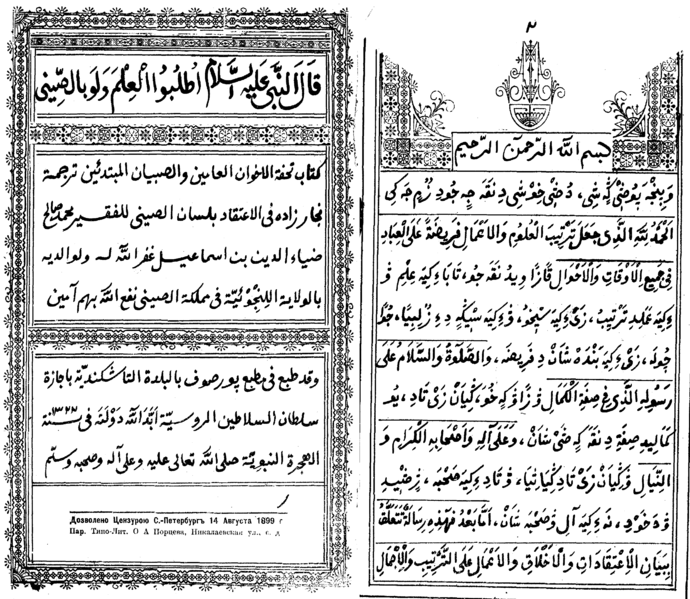
Did you know that the Chinese Muslims could write Chinese with Arabic letters, like we write Malay in Jawi? They call it Xiao'erjing. Here's an example -

Here's an old kitab in Xiao'erjing Chinese translation of Arabic on the left -

Also, I bet you did not know that in Chinese, halal is called qīngzhēn cài (清真菜) or "pure truth food." A mosque is called qīngzhēn sì (清真寺) or "pure truth temple.".

How beautiful.