Monday, January 21, 2008

Pork Sausages Galore


Chinese New Year is coming, and Chinatown is gearing up for it.

I walked through a Chinatown street just now to get to the subway from my office, and walked gingerly past a long row of pork sausage stalls trying to avoid contact. Yes, it is in the air .... the war between pigs and the Chinese.

Muslims had just commemorated their new year, and it is based on the lunar month calendar system. The Chinese have a combined lunar-solar calendar.

For convenience, here are the dates of the Chinese festivals coming up (from wikipedia) -

Holidays

The Chinese calendar year has nine main festivals, seven determined by the lunisolar calendar, and two derived from the solar agricultural calendar. (Farmers actually used a solar calendar, and its twenty-four terms, to determine when to plant crops, due to the inaccuracy of the lunisolar traditional calendar. However, the traditional calendar has also come to be known as the agricultural calendar.) The two special holidays are the Qingming Festival and the Winter Solstice Festival, falling upon the respective solar terms, at ecliptic longitudes of 15° and 270°, respectively. As for all other calendrical calculations, the calculations use civil time in China, UTC+8.

Date English Name Chinese Name Remarks 2008


month 1
day 1
Chinese New Year (Spring Festival) 春節
chūnjié
Family gathering and festivities for 3–15 days Feb 7


month 1
day 15
Lantern Festival 元宵節
yuánxiāojié
Yuanxiao eating
and lanterns
Feb 21


Apr 4
or 5
Qingming Festival (Clear and Bright) 清明節
qīngmíngjié
Tomb sweeping Apr 4


month 5
day 5
Dragon Boat Festival 端午節
duānwǔjié
Dragon boat racing
and zongzi eating
Jun 8


month 7
day 7
Night of Sevens 七夕
qīxī
For lovers, like Valentine's Day Aug 7


month 8
day 15
Mid-Autumn Festival (Moon Festival)[1] 中秋節
zhōngqiūjié
Family gathering and moon cake eating Sep 14


month 9
day 9
Double Ninth Festival (Double Yang) 重陽節
chóngyángjié
Mountain climbing
and flower shows
Oct 7


month 10
day 15
Xia Yuan Festival 下元節
xiàyuánjié
Pray for a peaceful year to the Water God Nov 12


Dec 21 or 22 Winter Solstice Festival 冬至
dōngzhì
Family gathering Dec 21


month 12
day 23
Kitchen God Festival

Jan 18


Point to note - the Lantern Festival mentioned above is not the same as the one celebrated in Singapore, which is known as the Mid-Autumn Festival in China. The Chinese in Singapore do not observe the Lantern Festival mentioned above.

Tomorrow is Thaipusam. I have not seen one of those in a long time. When I was in secondary school, my school was located at Serangoon Road, and the whole region would be congested with kavadi carriers and their supporters. It was an experience, really.

This reminds me of why I love being in Singapore. So many cultures, so many faiths, and nobody bugs you about yours.

Alhamdulillah.

Sunday, January 20, 2008

Inspirations : Sir Ahmed Hassanein


I was reading about Sir Edmund Hilary and was reflecting about what a truly inspirational man he was. When I was a child, everyone knew "Sir Edmund Hilary who climbed Mount Everest with Tensing Norgay".

In reasearching on Sir Edmund on the net, I found another adventurer, albeit of a different nature, in the form of Sir Ahmed Hassanein. Here is the short description of him in Wikipedia -

"Ahmed Pasha Hassanein (1889 - 1946) - Egyptian explorer, diplomat, one of two non-European winners of Gold Medal of Royal Geographical Society in 1924, King's chamberlain, fencing participant to 1924 Olympics, photographer, author and discoverer of Jebel Uweinat, and writer of "The Lost Oases" book in three languages."

It was interesting enough, but when I read the details, I was immediately enraptured by this man. Son of a sheikh of al-Azhar, but graduate from Oxford? Explored the then unexplored Sahara desert and discovered evidence of civilisation even earlier than the pyramid-builders, from a time when the Sahara was fertile?

Interesting description of him -
"... explains Rennell Rodd’s remarks in his introduction, where he says that Hassanein had consulted him ‘in a very delicate matter’ in which he proved himself to be ‘generous in his judgements and, for I know no other way of expressing what I mean, a great gentleman’. Rosita had fallen in love with Hassanein, but the details are hidden behind Hassanein’s discretion and Rosita’s catty remarks. It was said in Cairo that she would climb into his tent and try to seduce him, but that Hassanein refused her. ‘I was determined not to offend Allah and his mercy’, Hassanein is remembered to have said, ‘for we were in the midst of uncharted desert with the perils of death surrounding us on all sides.’".

Read the rest in Wikipedia.

Masjid Darul Gufran This Morning


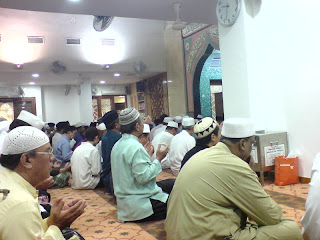
This morning the whole Mudpie family went for subuh prayer at our neighbourhood mosque, Masjid Darul Gufran at Tampines.

The imam was a young man, a graduate from the Natuonal University of Malaysia, and alumni of Madrasah Aljunied here. I know him because he did a stint of internship at my office a few years ago whilst still in university.

He gave the customary kuliah subuh (dawn talk) that mosques have on Sundays, and it was on how he read in the Readers' Digest about the health benefits of rising early, and also about how we should be wary of our words. He quoted Imam al-Gazzali who said that words can be sharper than swords. He cautioned us not to be carried away with speech trends, that just because some young people nowadays are freely using certain expressions today, we must remember that we are in an Asian setting, where language is not merely meant for function, but indicates a person's character as well.

He recounted how when he went to Malaysia, some of his colleagues chided him for using "aku" ("I") and "kau" ("you"), even though these pronouns are commonly used here and now. He was advised that these terms were disrespectful and used to insult the other person.

How interesting. I was always taught not to use those terms as they are rude. I felt some discomfort when I read a short novel in the Malay newspaper which used these terms. I guess their use has become prevalent her nowadays because our people think first in English and translate into Malay, so "I" becomes "aku" and "you" becomes "awak".

Also, I remember when I was a child people always referred to Rasulullah s.a.w. as "Baginda" ("His Majesty") and never as "Rasulullah" or "Nabi". In Malay, certain words are used for royalty only, and these can be used to Rasulullah. Some words are reserved only for Him, such as we are never supposed to use the word "mati" for His death, but "wafat" instead; and not "kata" for "said", but "sabda".

As you must have noticed, I have decided to use a capital letter to start to refer to Him. I guess this is the least I could do.


Saturday, January 19, 2008

Excited : Something to look forward to


I am so excited. I stumbled on this on amazon.com. It is coming soon, insha Allah. By the way, here's the only picture I have ever seen of the man.

The Shaykh le Gai Eaton gave a speech at the Radical Middle Way.

Here's the podcast.

Here is a nice example of his writing, for the uninitiated, and another.

Crossroad check : Ashura, Judaism, Madinah and The Prophet

An interesting article examines the question : What was the Jewish festival that our Master was referring to which he saw them observing in Madinah that we now know of as Ashura?

Thursday, January 17, 2008

Masjid Jamae Chulia at South Bridge Road


Masjid Jamae Chulia
Originally uploaded by LilMudPie
I've been going to this mosque for daily prayers as well as for Friday prayers as it is the nearest to my office. It is all in Tamil, which I dont understand a word of. It is a very old mosque, built by the very first generation of immigrants, and stands right next to a famous Hindu temple. This mosque is the centre for Tamil Muslim culture and learning in Singapore. Although located along a very busy street, the walls prevent the noise from coming into the mosque itself, so it is quite serene inside. A little dilapidated, and needs to be more woman-friendly, in my view. Lots of tourists come in to see what a mosque looks like. I guess for many of them it would be the first contact with Islam.

DVD Review : The Willow Tree

I borrowed this DVD, something I just had to do, being a lifelong movie fan and a Muslim who looks for spiritual learning points in every film.

Majid Majidi is the director of this delightful Iranian film. This is his latest, and came out last year. The story is about a blind person named Yusuf gaining his sight in answer to his prayers.

This is Majidi's most overtly religious of all his films. Yusuf is a blind professor of Persian literature, and his specialty is Rumi. In spite of his blindness he is a successful professor, a husband and father. He prays for God to give him sight as he had always been grateful for what he has been given.

The moral of the story is be careful what you pray for, and be grateful for what you are not given.

Gaining sight was ecstatic for Yusuf, presented in the way which only Majidi would. He jumps about like a little child in the hospital. Gradually, after the celebration is over, the challenges that come with eyesight set in. He sees pretty girls for the first time and sees his wife for the first time - she is plain. He sees a pickpocket on the subway. He sees ugliness.

I must confess I do not rate this film as highly as his Children of Heaven and The Colour of Paradise - which, if they were books, would be Sufi manuals by themsleves. I also loved Baran, although less so, but I would rank The Willow Tree to be my least favourite.

Wednesday, January 16, 2008

New School Term Begins


Masjid Darul Gufran
Originally uploaded by LilMudPie
Here's a picture I took last year at the first day at weekend madrasah at Masjid Darul Gufran for Omar. It was cute how the little 7-year olds are learning how to pray in congregation.

Masjid Hj Mohd Salleh at Palmer Road

Here's a snapshot I took of inside Masjid Haji Mohd Salleh at Palmer Road, the one attached to the shrine of Habib Noh, the saint of Singapore. It is a small little hut of a mosque in the middle of the busy city area, but located slightly apart from the skyscrapers so that it remains serene and disconnected. A true oasis it is. When I was working in that area for a few years, I used to love to go there for 'asr prayer and stay on for maghrib before leaving for home. I feel I can leave all the hustle and stress behind me there when I pick up a Qur'an and just read it softly. I always found comfort and strength in this mosque.

Masjid Sultan


Masjid Sultan 4
Originally uploaded by LilMudPie
I was at Masjid Sultan last Sunday, just to pop in for zohor prayer, when I noticed how beautiful it was.

Saturday, January 12, 2008

DVD Review : Kingdom of Heaven


I re-saw Kingdom of Heaven a few days ago.

The first time I saw it was when it was first released on DVD, about a year ago.

I felt it was a disappointment then.

In retrospect, I guess at that time, memories of Gladiator were still too fresh in everyone's minds, and we were all waiting for a bigger and better, more macho and violent, sequel to it.

It did not help that Kingdom was heavily promoted as being by the same director who gave you Gladiator.

When Kingdom did not meet these expectations, I guess we all quickly wrote it off.

There was a beauty of re-watching Kingdom two years later.

This time the ghost of Gladiator is well forgotten, and Kingdom could be judged on its own merits, outside Gladiator's shadow.

Looking at it again, I realised that Kingdom was clearly not meant to be a mere follow up act to Gladiator.

Gladiator was a pure visceral adrenaline rollercoaster ride of a film, meant to engage your guts more than your heart. There was no message there except "rip the guts out of the emperor in the most spectacularly bloody way possible".


Kingdom had its exciting moments, but none anywhere close to Gladiator in spectacle.

However, Kingdom was clearly a film with a message, and the director Ridley Scott (Alien, Blade Runner, Thelma and Louise, Legend, Matchstick Men, A Good Year, Black Hawk Down, American Gangster) was messaging more in this film than any other before.

In the second viewing of Kingdom, I grew to like Orlando Bloom.

Whereas he was everyone's unanimous choice as the reason why the film flopped, I now think he is perfect for the part.

He does not look too European, he is clean cut, and youthful-looking, which stands him out from the rest of the jaded, war-weary souls in Jerusalem.

He looks the perfect hero to negotiate the surrender of Jerusalem - can you imagine a more macho Hollywood actor like Russel Crowe doing something like - surrendering - to Arabs?

Anyway, I liked some of the musings thrown about in the film, which is more noticeable only in a second viewing.

Ed Norton was brilliant even with a mask on -


He exuded beauty of character trapped in deformity of body.

Ed Norton, well, he is just great as an actor to project a commanding presence without showing his face the whole time.

Eva Green (my current hot favourite actress) was clearly the token female character, but she provided a good bridge between the players and provided a little love interest to break the dramatic tension.

I must say that she looked smashing whilst decently dressed, even with hijab. That's another thing in this movie you probably will never see anywhere else.


The British actors were stereotyped as - well - characters speaking with British accents.

One of them is Jeremy Irons (whose voice I will always remember reading the Alchemist in my car CD) and another is the guy who appears in the TV series Heroes as the invisible man. Of course, Liam Neeson too.

The theme of the film is about the pointlessness of war.

The war in Jerusalem was pointlesss then, and it is pointless now.

Balian (Orlando Bloom) asks Salahuddeen "What is Jerusalem?" and the latter answers "Nothing - everything!".

To understand this we must realise that just before than Balilan had threatened to destroy all the holy places in Jerusalem, and that for each Crusader killed, 10 Muslims would be killed, leaving Salahuddeen with no army thereafter.

The reply from Salahuddeen was not what one would expect.

His answer to Balian's threat to destroy the city was "I wonder if it would not be better that you did" - indicating he does not care about the buildings.

And his answer to Balian's threat to kill 10 Muslim soldiers for each Crusader, Salahuddeen's answer was "You have women and children in your city, what about them?".

With Balian clearly left with nothing to negotiate with, Salahuddeen nevertheless offers the Christian safe passage out of Jerusalem.

His victory was not to be only military, but moral as well.

To offer your enemy a gift at the moment when you have defeated him - it reminds me of our Master, the Prophet, himself did at the liberation of Mecca.


There are lessons to all of us in this movie.

Many Muslims are clamouring for defeat of the Israelis and re-conquest of Jerusalem.

However, we forget that Jerusalem had been conquered by the Muslims twice before in history.

First, it was under Syiddina Omar.

There was no blood shed in the city.

The Christians gave the keys to the Church of Holy Sepulchre to him.

Second, when Salahuddeen re-took it from the Crusaders.

Again he negotiated a bloodless surrender.

In neither case did the Muslim side spill blood in Jerusalem.

Now, Jerusalem is the third holiest city in Islam. Like the other two, it should be treated as sacrosanct.

In Makkah and Madinah, it would be unthinkable to spill blood.

However, in Jerusalem now, blood flows like water.

I personally believe that Jerusalem will never be liberated from the Israelis simply because the people defiling it now are the Muslims.

We defile it with the blood of innocents everyday.

Also, we all know that Hamas is Saudi-backed, and the minute they were to take over Jerusalem, they would demolish al-Aqsa mosque and rebuild it in a more "Islamic" form - meaning no more Dome of the Rock, which is actually a shrine to heretical innovation in the eyes of Wahabbism.

The Palestinian people have to wake up and realise that.

The day we treat Baitulmaqdis with reverence is the day that we deserve her, and God will only give us what we deserve, right?

Tuesday, January 08, 2008

Beautiful sunset in kuching


We went to Kuching, Sarawak for a few days in December, right after my nephew's wedding.

It was rainy in Kuching, but it was nice and scenic nevertheless.

Sunday, September 23, 2007

Tarawih at the renovated Masjid Taqwa


Masjid Taqwa, which is the nearest mosque to my place, was re-opened in time for tarawih. Unfortunately, it is just a renovation, and not much bigger than before.

On the first night of tarawih, my wife did not have space to pray. So for a few nights thereafter we decided to go elsewhere, such as Masjid Baalwi, which was our frequent last year. However, with the kids being in morning session school this year, going to Baalwie, and consequently coming home late, was not feasible.

So we tried Masjid al-Istighfar at Pasir Ris. This turned out wonderful. My father in law and I loved that mosque. Although a big mosque, it had a neighbouorhood atmosphere. Maybe it is because the mosque committee and the imams greeted people as they come into the mosque and gestured them in.

Friday, February 23, 2007

An Other Cup


Maybe There's A World Lyrics

I have dreamt of a place and time,
where nobody gets annoyed,
But I must admit I'm not there yet but
Something's keeping me going

Maybe there's a world that I'm still to find
Open up o world and let me in,
Then there'll be a new life to begin

I have dreamt of an open world,
Borderless and wide
Where the people move from place to place
And nobody's taking sides

Maybe there's a world that I'm still to find
Open up a world and let me in,
Then there'll be A new life to begin

I've been waiting for that moment
To arrive
All at once the palace of peace
Will fill My eyes - how nice!

Maybe there's a world that I'm still to find
Open up a world and let me in,
Then there'll be A new life to begin

I've been waiting for that moment
To arrive
All at once the wrongs of the world,
Will be put right - how nice!

When We're Older

When we’re older
And full of cancer
It doesn’t matter now,
Come on, get happy,
‘Cause nothing lasts forever,
And I will always love you.

— Marianne Faithful

Monday, February 19, 2007

Father & Daughter

This short film was nominated for an Oscar for Best Short Animated Film, but lost out to The Perriwig Maker.

It is a sad story with a puzzling conclusion.

Issues arose in my mind.

Our separation from our Creator. Our Creator who loves us but leaves us in the world seemingly without reason. We are unable to understand why or what happened. We yearn for Him, but He is not with us physically, and does not return. We carry on with life. Things change. The world changes. We change. At the end, we return to Him where we last were left by Him. We are never really sure if we would ever meet Him again. When we do, He is as He always was, unchanged, as we last remember Him. We also return to Him in the way that we were, children to Him.

Our yearning for the Divine is the yearning of the orphan for the lost parent. It is no coincidence that our Master the Prophet was an orphan in this world, even though his parents were young when they died. He teaches us, and the Qur'an teeaches repeatedly, that we must be kind to the orphan, that He found us as orphans. This can be read in the spiritual sense as well, for we are all orphans in this world, cut off from our true parent - God.

There is a hadith where our Master the Prophet of God said to the effect that on the Day of Judgment the believer will meet his Lord like a child that has been separated from its mother.

The film would be totally meaningless if not for the fact that most of it is about the daughter's constant remembering of her lost father. It is because of her keeping his memory alive that she is reunited with him in the end. It makes me reflect - that just as the daughter in this film kept the memory of her father alive all those years - do I remember God enough? Would I be as glad to see Him and run into His embrace when I see Him on Judgment Day? Or would I be amongst those who would not recognise Him or run away from His wrath instead?

Pray Before You Are Prayed For

Here is a cute advert to remind people to pray. I like the idea of the mediabyte dakwah in the context of the present world. You cant get people's attention in any other way, nowadays.

Friday, February 16, 2007

Peace & Poverty

Yusuf Islam performed live at the Nobel Peace Prize 2006 Award.

It is without exaggeration that I say that watching it nearly brought tears to my eyes.
I can tell from the video that it moved thousands of the people in the audience there too.
When I was in primary and secondary school, Cat Stevens was the greatest pop singer in the world.
He was known by everyone.
His music was not trashy commercialism, but thoughtful and contained the message of gentleness and peace, and that was why he struck a chord with the youth of the time, in the midst of the drugs and rock and roll music of the crazy 70s.
When he dropped out of the pop music scene, the whole tenor of pop music changed.

Suddenly now, 30 years later, to our surprise, he appears on stage.
He sings, and his voice has not changed at all since the 70s.
He sings, and at the Nobel Peace Prize Award ceremony, as the quiet troubadour of peace that he always was.
Thousands of the people in the audience are clearly Western people who are of the age that grew up on his music and remember loving him then.
And now he is back.
Like a brother who disappeared without a trace when you were a kid who suddenly comes back to your door today.

That day was a special event.
In my measure two of the greatest Muslims of the world in the same place - both of whom have done more for more people that we can imagine - one empowering the poorest of the poor to break their chains of despondency, the other illuminating the hearts of the lost and wandering to find their way to everlasting Love and Happiness.

'I feel right about making music and singing about life in this fragile world again,' Yusuf says of his return to the pop music world. 'It is important for me to be able to help bridge the cultural gaps others are sometimes frightened to cross.'

Next point - who won the Nobel Peace Prize that is so great that Yusuf comes out of singing retirement to sing for?
He is, to me, the probably greatest Muslim to be walking the Earth at this moment.
He made it possible for millions of people in the poorest countries of the world climb out of hopeless poverty, without riches to himself, without hogging the headlines.
He is Muhammad Yunus from Bangladesh.
God bless this man!


Read his acceptance speech here.

How he started this immmense (and I would say unimaginable) project he describes like this :

I became involved in the poverty issue not as a policymaker or a researcher. I became involved because poverty was all around me, and I could not turn away from it. In 1974, I found it difficult to teach elegant theories of economics in the university classroom, in the backdrop of a terrible famine in Bangladesh. Suddenly, I felt the emptiness of those theories in the face of crushing hunger and poverty. I wanted to do something immediate to help people around me, even if it was just one human being, to get through another day with a little more ease. That brought me face to face with poor people's struggle to find the tiniest amounts of money to support their efforts to eke out a living. I was shocked to discover a woman in the village, borrowing less than a dollar from the money-lender, on the condition that he would have the exclusive right to buy all she produces at the price he decides. This, to me, was a way of recruiting slave labor.

I decided to make a list of the victims of this money-lending "business" in the village next door to our campus.

When my list was done, it had the names of 42 victims who borrowed a total amount of US $27. I offered US $27 from my own pocket to get these victims out of the clutches of those money-lenders. The excitement that was created among the people by this small action got me further involved in it. If I could make so many people so happy with such a tiny amount of money, why not do more of it?

That is what I have been trying to do ever since. The first thing I did was to try to persuade the bank located in the campus to lend money to the poor. But that did not work. The bank said that the poor were not creditworthy. After all my efforts, over several months, failed I offered to become a guarantor for the loans to the poor. I was stunned by the result. The poor paid back their loans, on time, every time! But still I kept confronting difficulties in expanding the program through the existing banks. That was when I decided to create a separate bank for the poor, and in 1983, I finally succeeded in doing that. I named it Grameen Bank or Village bank.


I believe that we can create a poverty-free world because poverty is not created by poor people. It has been created and sustained by the economic and social system that we have designed for ourselves; the institutions and concepts that make up that system; the policies that we pursue.
Today, Grameen Bank gives loans to nearly 7.0 million poor people, 97 per cent of whom are women, in 73,000 villages in Bangladesh. Grameen Bank gives collateral-free income generating, housing, student and micro-enterprise loans to the poor families and offers a host of attractive savings, pension funds and insurance products for its members. Since it introduced them in 1984, housing loans have been used to construct 640,000 houses. The legal ownership of these houses belongs to the women themselves. We focused on women because we found giving loans to women always brought more benefits to the family.

In a cumulative way the bank has given out loans totaling about US $6.0 billion. The repayment rate is 99%. Grameen Bank routinely makes profit. Financially, it is self-reliant and has not taken donor money since 1995. Deposits and own resources of Grameen Bank today amount to 143 per cent of all outstanding loans. According to Grameen Bank's internal survey, 58 per cent of our borrowers have crossed the poverty line.

Grameen Bank was born as a tiny homegrown project run with the help of several of my students, all local girls and boys. Three of these students are still with me in Grameen Bank, after all these years, as its topmost executives. They are here today to receive this honour you give us.


This idea, which began in Jobra, a small village in Bangladesh, has spread around the world and there are now Grameen type programs in almost every country.

A human being is born into this world fully equipped not only to take care of him or herself, but also to contribute to enlarging the well being of the world as a whole. Some get the chance to explore their potential to some degree, but many others never get any opportunity, during their lifetime, to unwrap the wonderful gift they were born with. They die unexplored and the world remains deprived of their creativity, and their contribution.


All I can surmise at the end of this is this - this man, with his sincere intentions and added to it sincere devotion and love for others, is aided only by the Divine, for only by miracle did he succeed as he did - to help others. In an age where we marvel at accomplishments in terms of how lavish, how expensive, how luxurious, how bloody they are, here is an accomplishment which places all the others in the shade.

Our Master the Beloved Prophet of God said, "None of you are true believers unless and until you love for your brother what you would love for yourselves.".

It is so fitting that Yusuf Islam sang the most appropriate of his songs, so beautifully at this event.


Saturday, February 10, 2007

Farewell Old Friend


15-10-06_1058
Originally uploaded by LilMudPie.

I took this photo of my cable TV decoder box and remote 4 months ago.
I then went over to Starhub and surrendered it to them and cancelled my cable TV subscription.
5 months ago I gave the TV in my bedroom to my mother, and 6 months ago the main TV in the living room of our home sort of blew up and had to be carted away.
In short, 6 months ago God smote my TV.

The first few weeks were the worst. We craved for our daily dose.
We wondered what happened to our TV characters in our cartoons and miniseries. We suddenly had hours of spare time.
We didnt know what to look at when we sat in the living room.

We adjusted our living room furniture so that we no longer faced the Great Altar That Presides In Everybody's Temple.
Our sofas, and us in it, now face each other.
We placed our family photos on the TV console.
That helped.

We developed other things to do in the spare time. Homework no longer gets undone.
Prayer does not get delayed by something happening on TV anymore.
We read a lot more than before.
We talk a lot more to each other now.

The home is peaceful - so peaceful.
No background noise of cartoon yells, car crashes, gunshots, shouting music, canned laughter.
We no longer know - nor care - about what happens to the non-existent people in the non-existent worlds of television shows anymore.

In his book, Amusing Ourselves To Death, Neil Postman, writing 20 years ago, observed that the people in our society today show a disproportionate interest in fictional happenings (most TV shows are fictional) and in events that have no effect on them (hyperinformationalism, or obsession with news of events in places we have no connection or control over).
I personally believe that these two things are spiritually toxic.
They serve the function of drawing our attention away from our inner selves.
By knowing our selves do we know God, said our Master the Prophet (prayer and peace be upon Him).
How much time do we spend on introspection and self-evaluation if we are occupied for hours staring at fictitious worlds and distant events?
Given, some measure of intellectual escapism is needed to give a person some perspective in life, and as such fictional literature, and its visual parallel, film, can play a positive role in a person's spiritual quest - but always in levels that WE control, certainly not in the overwhelming presence that IT controls US.

Tuesday, February 06, 2007

Il Mare

As you probably know by now, I'm a sucker for sappy movies. I watched Il Mare last night with Mrs MudPie.

Here's a review. There is also a music video from the soundtrack of the film.

Well, this movie was what The Lake House was adapted from. It is definitely different. Without comparing with the Lake House, I would say I liked it.

What is it about love that makes people cynical?
Love is the most natural and divine emotion we can have.
When a child is born, the only emotion it has is unconditional love.
Contrast with impatience and anger, as the Prophet (may God bless Him and give Him peace) said, are not from God, but from the Devil.
So an emotion like love must be from God.
Now, there is love that is pure and free from lust - not just sexual lust, but the lust of the ego, such as people who fall in love to fulfil themselves and to make themselves happy.
The love that is free of all these is pure, and we inherit this from our embedded memories of when we were in the state of bliss before we were placed in our mothers' wombs, when we were in the paradisical pre-beginning, and were directly aware of God, loving Him and basking in His love.
In my opinion, this explains why we all yearn for love in this world, groping to find only incomplete substitutes for the Incomparable.

Back to Il Mare. The thing I like about this film, and The Lake House for that matter, is that because the characters are physically separated by time, there is no possibility of physical intimacy or physical attraction.
In a world where it has become stock of trade for films to portray sex scenes (explicit or implied) to communicate to the audience the passionate emotion between two people, these two films have been able to dispense with it altogether.