Sunday, September 23, 2007

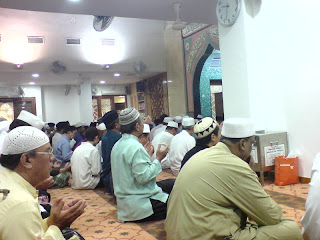
Tarawih at the renovated Masjid Taqwa


Masjid Taqwa, which is the nearest mosque to my place, was re-opened in time for tarawih. Unfortunately, it is just a renovation, and not much bigger than before.

On the first night of tarawih, my wife did not have space to pray. So for a few nights thereafter we decided to go elsewhere, such as Masjid Baalwi, which was our frequent last year. However, with the kids being in morning session school this year, going to Baalwie, and consequently coming home late, was not feasible.

So we tried Masjid al-Istighfar at Pasir Ris. This turned out wonderful. My father in law and I loved that mosque. Although a big mosque, it had a neighbouorhood atmosphere. Maybe it is because the mosque committee and the imams greeted people as they come into the mosque and gestured them in.

Friday, February 23, 2007

An Other Cup


Maybe There's A World Lyrics

I have dreamt of a place and time,
where nobody gets annoyed,
But I must admit I'm not there yet but
Something's keeping me going

Maybe there's a world that I'm still to find
Open up o world and let me in,
Then there'll be a new life to begin

I have dreamt of an open world,
Borderless and wide
Where the people move from place to place
And nobody's taking sides

Maybe there's a world that I'm still to find
Open up a world and let me in,
Then there'll be A new life to begin

I've been waiting for that moment
To arrive
All at once the palace of peace
Will fill My eyes - how nice!

Maybe there's a world that I'm still to find
Open up a world and let me in,
Then there'll be A new life to begin

I've been waiting for that moment
To arrive
All at once the wrongs of the world,
Will be put right - how nice!

When We're Older

When we’re older
And full of cancer
It doesn’t matter now,
Come on, get happy,
‘Cause nothing lasts forever,
And I will always love you.

— Marianne Faithful

Monday, February 19, 2007

Father & Daughter

This short film was nominated for an Oscar for Best Short Animated Film, but lost out to The Perriwig Maker.

It is a sad story with a puzzling conclusion.

Issues arose in my mind.

Our separation from our Creator. Our Creator who loves us but leaves us in the world seemingly without reason. We are unable to understand why or what happened. We yearn for Him, but He is not with us physically, and does not return. We carry on with life. Things change. The world changes. We change. At the end, we return to Him where we last were left by Him. We are never really sure if we would ever meet Him again. When we do, He is as He always was, unchanged, as we last remember Him. We also return to Him in the way that we were, children to Him.

Our yearning for the Divine is the yearning of the orphan for the lost parent. It is no coincidence that our Master the Prophet was an orphan in this world, even though his parents were young when they died. He teaches us, and the Qur'an teeaches repeatedly, that we must be kind to the orphan, that He found us as orphans. This can be read in the spiritual sense as well, for we are all orphans in this world, cut off from our true parent - God.

There is a hadith where our Master the Prophet of God said to the effect that on the Day of Judgment the believer will meet his Lord like a child that has been separated from its mother.

The film would be totally meaningless if not for the fact that most of it is about the daughter's constant remembering of her lost father. It is because of her keeping his memory alive that she is reunited with him in the end. It makes me reflect - that just as the daughter in this film kept the memory of her father alive all those years - do I remember God enough? Would I be as glad to see Him and run into His embrace when I see Him on Judgment Day? Or would I be amongst those who would not recognise Him or run away from His wrath instead?

Pray Before You Are Prayed For

Here is a cute advert to remind people to pray. I like the idea of the mediabyte dakwah in the context of the present world. You cant get people's attention in any other way, nowadays.

Friday, February 16, 2007

Peace & Poverty

Yusuf Islam performed live at the Nobel Peace Prize 2006 Award.

It is without exaggeration that I say that watching it nearly brought tears to my eyes.
I can tell from the video that it moved thousands of the people in the audience there too.
When I was in primary and secondary school, Cat Stevens was the greatest pop singer in the world.
He was known by everyone.
His music was not trashy commercialism, but thoughtful and contained the message of gentleness and peace, and that was why he struck a chord with the youth of the time, in the midst of the drugs and rock and roll music of the crazy 70s.
When he dropped out of the pop music scene, the whole tenor of pop music changed.

Suddenly now, 30 years later, to our surprise, he appears on stage.
He sings, and his voice has not changed at all since the 70s.
He sings, and at the Nobel Peace Prize Award ceremony, as the quiet troubadour of peace that he always was.
Thousands of the people in the audience are clearly Western people who are of the age that grew up on his music and remember loving him then.
And now he is back.
Like a brother who disappeared without a trace when you were a kid who suddenly comes back to your door today.

That day was a special event.
In my measure two of the greatest Muslims of the world in the same place - both of whom have done more for more people that we can imagine - one empowering the poorest of the poor to break their chains of despondency, the other illuminating the hearts of the lost and wandering to find their way to everlasting Love and Happiness.

'I feel right about making music and singing about life in this fragile world again,' Yusuf says of his return to the pop music world. 'It is important for me to be able to help bridge the cultural gaps others are sometimes frightened to cross.'

Next point - who won the Nobel Peace Prize that is so great that Yusuf comes out of singing retirement to sing for?
He is, to me, the probably greatest Muslim to be walking the Earth at this moment.
He made it possible for millions of people in the poorest countries of the world climb out of hopeless poverty, without riches to himself, without hogging the headlines.
He is Muhammad Yunus from Bangladesh.
God bless this man!


Read his acceptance speech here.

How he started this immmense (and I would say unimaginable) project he describes like this :

I became involved in the poverty issue not as a policymaker or a researcher. I became involved because poverty was all around me, and I could not turn away from it. In 1974, I found it difficult to teach elegant theories of economics in the university classroom, in the backdrop of a terrible famine in Bangladesh. Suddenly, I felt the emptiness of those theories in the face of crushing hunger and poverty. I wanted to do something immediate to help people around me, even if it was just one human being, to get through another day with a little more ease. That brought me face to face with poor people's struggle to find the tiniest amounts of money to support their efforts to eke out a living. I was shocked to discover a woman in the village, borrowing less than a dollar from the money-lender, on the condition that he would have the exclusive right to buy all she produces at the price he decides. This, to me, was a way of recruiting slave labor.

I decided to make a list of the victims of this money-lending "business" in the village next door to our campus.

When my list was done, it had the names of 42 victims who borrowed a total amount of US $27. I offered US $27 from my own pocket to get these victims out of the clutches of those money-lenders. The excitement that was created among the people by this small action got me further involved in it. If I could make so many people so happy with such a tiny amount of money, why not do more of it?

That is what I have been trying to do ever since. The first thing I did was to try to persuade the bank located in the campus to lend money to the poor. But that did not work. The bank said that the poor were not creditworthy. After all my efforts, over several months, failed I offered to become a guarantor for the loans to the poor. I was stunned by the result. The poor paid back their loans, on time, every time! But still I kept confronting difficulties in expanding the program through the existing banks. That was when I decided to create a separate bank for the poor, and in 1983, I finally succeeded in doing that. I named it Grameen Bank or Village bank.


I believe that we can create a poverty-free world because poverty is not created by poor people. It has been created and sustained by the economic and social system that we have designed for ourselves; the institutions and concepts that make up that system; the policies that we pursue.
Today, Grameen Bank gives loans to nearly 7.0 million poor people, 97 per cent of whom are women, in 73,000 villages in Bangladesh. Grameen Bank gives collateral-free income generating, housing, student and micro-enterprise loans to the poor families and offers a host of attractive savings, pension funds and insurance products for its members. Since it introduced them in 1984, housing loans have been used to construct 640,000 houses. The legal ownership of these houses belongs to the women themselves. We focused on women because we found giving loans to women always brought more benefits to the family.

In a cumulative way the bank has given out loans totaling about US $6.0 billion. The repayment rate is 99%. Grameen Bank routinely makes profit. Financially, it is self-reliant and has not taken donor money since 1995. Deposits and own resources of Grameen Bank today amount to 143 per cent of all outstanding loans. According to Grameen Bank's internal survey, 58 per cent of our borrowers have crossed the poverty line.

Grameen Bank was born as a tiny homegrown project run with the help of several of my students, all local girls and boys. Three of these students are still with me in Grameen Bank, after all these years, as its topmost executives. They are here today to receive this honour you give us.


This idea, which began in Jobra, a small village in Bangladesh, has spread around the world and there are now Grameen type programs in almost every country.

A human being is born into this world fully equipped not only to take care of him or herself, but also to contribute to enlarging the well being of the world as a whole. Some get the chance to explore their potential to some degree, but many others never get any opportunity, during their lifetime, to unwrap the wonderful gift they were born with. They die unexplored and the world remains deprived of their creativity, and their contribution.


All I can surmise at the end of this is this - this man, with his sincere intentions and added to it sincere devotion and love for others, is aided only by the Divine, for only by miracle did he succeed as he did - to help others. In an age where we marvel at accomplishments in terms of how lavish, how expensive, how luxurious, how bloody they are, here is an accomplishment which places all the others in the shade.

Our Master the Beloved Prophet of God said, "None of you are true believers unless and until you love for your brother what you would love for yourselves.".

It is so fitting that Yusuf Islam sang the most appropriate of his songs, so beautifully at this event.


Saturday, February 10, 2007

Farewell Old Friend


15-10-06_1058
Originally uploaded by LilMudPie.

I took this photo of my cable TV decoder box and remote 4 months ago.
I then went over to Starhub and surrendered it to them and cancelled my cable TV subscription.
5 months ago I gave the TV in my bedroom to my mother, and 6 months ago the main TV in the living room of our home sort of blew up and had to be carted away.
In short, 6 months ago God smote my TV.

The first few weeks were the worst. We craved for our daily dose.
We wondered what happened to our TV characters in our cartoons and miniseries. We suddenly had hours of spare time.
We didnt know what to look at when we sat in the living room.

We adjusted our living room furniture so that we no longer faced the Great Altar That Presides In Everybody's Temple.
Our sofas, and us in it, now face each other.
We placed our family photos on the TV console.
That helped.

We developed other things to do in the spare time. Homework no longer gets undone.
Prayer does not get delayed by something happening on TV anymore.
We read a lot more than before.
We talk a lot more to each other now.

The home is peaceful - so peaceful.
No background noise of cartoon yells, car crashes, gunshots, shouting music, canned laughter.
We no longer know - nor care - about what happens to the non-existent people in the non-existent worlds of television shows anymore.

In his book, Amusing Ourselves To Death, Neil Postman, writing 20 years ago, observed that the people in our society today show a disproportionate interest in fictional happenings (most TV shows are fictional) and in events that have no effect on them (hyperinformationalism, or obsession with news of events in places we have no connection or control over).
I personally believe that these two things are spiritually toxic.
They serve the function of drawing our attention away from our inner selves.
By knowing our selves do we know God, said our Master the Prophet (prayer and peace be upon Him).
How much time do we spend on introspection and self-evaluation if we are occupied for hours staring at fictitious worlds and distant events?
Given, some measure of intellectual escapism is needed to give a person some perspective in life, and as such fictional literature, and its visual parallel, film, can play a positive role in a person's spiritual quest - but always in levels that WE control, certainly not in the overwhelming presence that IT controls US.

Tuesday, February 06, 2007

Il Mare

As you probably know by now, I'm a sucker for sappy movies. I watched Il Mare last night with Mrs MudPie.

Here's a review. There is also a music video from the soundtrack of the film.

Well, this movie was what The Lake House was adapted from. It is definitely different. Without comparing with the Lake House, I would say I liked it.

What is it about love that makes people cynical?
Love is the most natural and divine emotion we can have.
When a child is born, the only emotion it has is unconditional love.
Contrast with impatience and anger, as the Prophet (may God bless Him and give Him peace) said, are not from God, but from the Devil.
So an emotion like love must be from God.
Now, there is love that is pure and free from lust - not just sexual lust, but the lust of the ego, such as people who fall in love to fulfil themselves and to make themselves happy.
The love that is free of all these is pure, and we inherit this from our embedded memories of when we were in the state of bliss before we were placed in our mothers' wombs, when we were in the paradisical pre-beginning, and were directly aware of God, loving Him and basking in His love.
In my opinion, this explains why we all yearn for love in this world, groping to find only incomplete substitutes for the Incomparable.

Back to Il Mare. The thing I like about this film, and The Lake House for that matter, is that because the characters are physically separated by time, there is no possibility of physical intimacy or physical attraction.
In a world where it has become stock of trade for films to portray sex scenes (explicit or implied) to communicate to the audience the passionate emotion between two people, these two films have been able to dispense with it altogether.

Thursday, February 01, 2007

Thinking About the Tortures of the Grave

The counsel which I give you is that you should not look too intently into the details of this matter or busy yourself with trying to understand it. Occupy yourself instead with warding this chastisement off by whatever means, for if you were to neglect your works and worship, and busy yourself with this matter instead you would resemble a man arrested and incarcerated by a sultan with a view to cuting off his hand or his nose, but who spent all night wondering whether he would be cut with a knife, a sword, or a razor, and neglected to devise a plan which might ward off the punishment itself, something which is the very height of folly.

It is known for certain that after his death the bondsman must meet either with dire punishment or with everlasting bliss. It is this that one should prepare for; to study the minutiae of chastisement and reward is superfluous and a waste of time.

Imam al-Ghazali - Ihya 'Ulum al-Din - the Chapter on the Remembrance of Death and the Afterlife.

Thursday, January 25, 2007

3 Handfuls of Earth

I've been attending a course on funerals for the last few months. I thought it would be my $0.02 worth to at least disseminate some of the less-known sunnahs attached to funerals.

One of the less known sunnahs is the throwing of 3 handfuls of soil into the open grave. I try to do it when I can, but in cases of burials of people I am not close to, I do not, because it draws quizzical stares, and I don't want to offend anybody at a sad event like a burial.

Anyway, here is an excerpt from Fiqh us-Sunnah (yes - I'm quoting from Fiqh us-Sunnah - to show that this practice is not a "new" innovation) -

[quote]
"It is desirable to encourage those attending the burial to throw three handfuls of soil over the grave from the head of the body.
This is based on a hadith by Ibn Majah which says: "The Prophet, peace be upon him, once offered a funeral prayer and then went to the deceased's grave and threw three handfuls of soil from near the deceased's head."
Abu Hanifah, Ash-Shafi'i, and Ahmad hold that when throwing the first handful one should say, "Of this (i.e. the earth) We created you," and on the second one should say, "And to it shall We cause you to return," and on the third handful one should say, "And of it We shall cause you to be resurrected a second time."
This is based on a hadith that the Prophet, peace be upon him, said this when his daughter Umm al-Kulthum was laid in her grave. " [end of quote]

"Of this We created you,
To it We cause you to return,
And of it We shall cause you to be resurrected."

Wednesday, January 24, 2007

Habib Umar bin Hafiz Coming to Singapore

20 / 02/ 2007
Masjid Ansar (mawlid aft maghrib)
talk is after Ishak

21/ 02/ 2007
Masjid Kassim (Short lecture)
at maghrib
and after Ishak Masjid Istigfar (talk)

22/ 02/ 2007
Masjid Mukminin (Short lecture)
aft Zuhur and
after Ishak Masjid Ba alawi

23 / 02/ 2007
Masjid Abdul Aleem Siddique
after Ishak (Qasida Burdah session aft Maghrib)

For info on Habib Umar, visit ihsan's blog at the Light of Eminence.

Watch this Video.

Syed Hussein Alatas Passes Away

The great thinker of Malay anthropology passed away in KL this morning.


“History is a conflict of two moral types - the predatory and the constructive - and these can be found in all societies, all civilizations”


Among his prominent books are The Sociology of Corruption (1968) , Kita dengan Islam (1972), Modernization and Social Change in Southeast Asia (1972), and The Myth of the Lazy Native (1977). They have left an indelible contribution to the thought behind the policies regarding the Malay people, whether amongst those who agree with him, as well as those who do not. That is the sign of the greatness of an idea, and a sign of the greatness of the mind behind it. May God bless him, and may be be with the One whom he loves. "Indeed from God we come, and indeed to Him is our return."


Corrections

I realised the links in my post on Abused Children Can't Speak Up did not work.
Have remedied the fault.
Subhanallah.

Monday, January 22, 2007

Travelling

MY picture for this blog profile is my walking stick.
Let me explain this.
In the Sufi tradition, there a few stages in the life of a person.
First is infancy, where a person is not responsible in the Syariah for what is done.
In this phase the person is essentially a learner, a follower.
The emphasis is physical development.
Then comes puberty which starts the phase of adulthood.
In this phase a person applies what is learnt, to earn a livelihood, to have a family, to mature.
The emphasis is on intellectual development.
This leads to the next phase, or maturity.
This is when the person has crossed the age of 40 years.
In this stage, the person has mastered the skills needed to survive or prosper in the world, and starts thinking about whether there is more to life.
If this spirit of inquiry and search is not given proper spiritual guidance, it ends up being channelled to other pursuits, and this is referred to as a midlife crisis by those who do not believe in spirituality.
In Sufism, this stage of searching and re-assessment markes the age where the person is actually spiritually mature.
The emphasis in this phase is spiritual development. Our Master the Prophet s.a.w. did state that the age of his ummah is 40 years, and anything more is a blessing.
Our Master the Prophet (s.a.w.) received his revelation, and thus his apostleship, at age 40.
God spoke to Moses (a.s.) on the mountain at the same age.
Now, in the Sufi tradition, upon reaching 40, certain sunnahs apply to a person which did not apply before.
One of them is the use of a walking stick.
Our Master the Prophet (s.a.w.) was known to have a stick with him on various occassions, based on the hadith descriptions of when he gave a Friday sermon and when he touched the Black Stone of the Kaabah with his stick instead of kissing it.
The Prophet Moses (a.s.) had a stick with him when he spoke to God on the mountain, and God told him to cast the stick on the ground, whereupon it became a serpent.
Imam as-Shafie always carried a walking stick. When asked why, he replied because it reminded him that he was a traveller in the world. This is a clear reference to the hadith of our Master that he is a traveller resting for a while in the shade of a tree, and he will soon move on.
The great Malay 'ulama HAMKA always carried a stick too.
Presently in Singapore, Ustaz Hasbi and Ustaz Zakaria Bagarib use walking sticks.

Now, Mrs Mudpie suggested that I follow this sunnah.
The idea struck me as strange. I procrastinated, and she bought me one.
I was taken by surprise, and, having no excuse left, I started to carry the stick with me.
It felt good. I felt that I was doing something that was in honour of the Prophet (s.a.w.).

The reactions I received were interesting.
Non-Muslims thought I had an injury or something, and they wished me a quick recovery.
This I could deal with, it is never my practice to declare the reasons behind the practices of my faith to others anyway.
Muslims who were not aware of the sunnah - when told it was a sunnah - usually reacted with scepticism, and viewed me suspiciously as if I was suddenly ascribing to some kind of strange cult. This I could deal with, I have always done things that were strange to others, as there are always people who do not understand.
Muslims who were aware of the sunnah - were encouraging and wished me well and left it at it, whereas some said it is not a relevant thing today and looked at me strangely.
This was a little more tricky.
On one hand it is good to receive positive feedback, but it can also lead to feelings of pride and arrogance, which would defeat the purpose of any act of worship.
In particular, I bumped into an imam of a mosque on 2 separate occassions by coincidence, and I had my stick with me. He didnt say anything, but later expressed wonder - about how "excellent" a person I was, to a friend of mine.
My friend relayed this to me, and I instinctively felt pride.
Then I just felt ashamed. Then I was befuddled. Was I making Islam more eccentric than necessary? What sort of da'wah was I doing? Is this sunnah something relevant in my context, not being a member of the asatizah community?
I didnt know what to do, so I stopped using the stick for a while.
I pondered whether I could still observe the sunnah in some other, possibly symbolic manner, for example. That led nowhere.

I re-analysed my use of the stick, and after consulting people who know better, I came to the following policy:
1. I shall carry the walking stick whenever I am at a place where I will be performing ibadah, such as the mosque, or majlis, or religious classes.
2. I shall carry a long umbrella in place of the stick on all other occassions.
3. I shall carry the walking stick when I dress "formally", that is, whenever I wear my turban or songkok. This is to complete the sunnah of the Prophet's s.a.w. dress code.
Okay, the whole thing sounds like much ado about nothing, but I believe that as far as possible, I would like to honour the Prophet s.a.w. in whatever best way that I can, and if by doing something that he practised I can in any way be like him, or at least be reminded of him, I would like to do it.
This sunnah of the stick is interesting, because unlike the other sunnahs, there is no fiqh attached to it, so there is no right or wrong about it.

There is no obvious purpose to this sunnah, and nothing else is connected to it.
So you end up with your own reasons and intentions for doing it.
Maybe that is intentionally so.
Maybe that is why this sunnah is reserved for those who have reached maturity.

Has the stick made a difference?

A definite yes. It reminds me that I am on my way.
Abused Children Cant Speak Up

In my years as a criminal lawyer, I have seen some terrible things.
Few are as bad as abuse to children.
Please take a look at this ad and look out for the children around you.
Abuse is more common than we would all like to think it is.
It only stops if other people stop it.

Children are abused precisely because they cannot speak up.
We must speak for them.
Too many children have died due to the silence of others.


HAMKA

"Apabila kemiskinan menanti dipintu kasih sayang akan lari keluar tingkap"
"When poverty awaits at the door, love runs out the window."

HAMKA pernah dipenjara Soekarno kerana menerbitkan tulisan Bung Hatta yang berjudul 'Demokrasi Kita' yang terkenal itu.
Tulisan itu berisi kritikan tajam terhadap konsep Demokrasi Terpimpin yang dijalankan Soekarno.
Namun dia tidak pernah menyimpan dendam pada Bung Karno.
Buktinya, ketika Bung Karno wafat, HAMKA-lah yang menjadi imam saat sholat jenazahnya.
Sikap yang berpegang pada prinsip dan hati ini tidak luput dari tempaan perjalanan hidupnya.
HAMKA was ever imprisoned by Sukarno for editing the famous writings of Hatta entitled "Our Democracy".
The writing was a sharp critique of the concept of Guided Democracy launched by Sukarno.
Nevertheless, HAMKA never kept a grudge against Sukarno.
This is evident in that when Sukarno later passed away, it was HAMKA who led the funeral prayer for him.
This attitude of holding on to his principles and his heart never faded from the route of his life's journey.

HAMKA was a great thinker, religious reformer, laureate, rebel commander, national leader, political prisoner of conscience, sufi, modernist, philosopher and most of all, a great person.

Who says we dont have saints anymore?

Self, Stone Thyself


"If you consider yourself honoured by the diamond, and humiliated by the stone, God is not with you."

- Attar

Sunday, January 21, 2007

Sufi Aphorism for the Day

"Men Are Scum."

That's the aphorism for today.
I see so many cases of men treating their women badly, that I believe it is in their nature that they are scum.
One of the girls working for me, she has 3 kids, came back from maternity leave a month ago depressed.
I thought it was post partum depression, but it turned out she discovered her husband had been sleeping over at his girlfriend's place when he should have been at night shift.
Then he had the nerve to try and blame her by saying that she neglected him.
What?
She just had his baby, for heaven's sake!
Then there is this Indonesian retaurant in Kandahar Street which is famous because its owner announces that he has two wives.
Recently Aa Gym took another one as well.
That Dato' in Malaysia divorced his wife of many years, mother of his grown children, who was with him during his rise to success, and married a floozy 20 years younger than him.
Dont get me wrong, I am not saying that men are scum because I think I am better.
Rather I am so frightened that it is something so innate and inherent in us that I pray I am given the strength to resist it and never succumb to it.
This is where the film Closer is informative.
At one point Natalie Portman's character said, there is always the opportnity to be unfaithful, but all you need is to say no.
The Elton John song goes - "It's no sacrifice- it's just a simple word."
Okay, so "Men Are Scum" is not a Sufi aphorism.
But it really should be.
We need to know our weakness so we can keep an eye on it.

Saturday, January 20, 2007

Scoop

I saw Scoop (2006) starring Woody Allen, Hugh Jackman and Scarlett Johansson.
My advice : skip it.