Saturday, March 08, 2008

A Sufi At The Singapore Film Festival

The 21st Singapore International Film Festival is coming up in April.
This year, we are blessed to have wonderful films which I think would be of interest to me, and hence, those of you who are reading this blog. I believe that film is a powerful multidimensional medium of communication, and it is a pity that too much of it is looked at for entertainment value only, missing out the messaging effect that each film has. Some of these films are not to everyone's taste, some include presentations of sexuality and prostitution, but in my view, they depict either moral corruption or spiritual darkness, or desparation that deserves our attention, and hopefully, rescue.
It is all too easy and human to hate the sinner and not the sin.

Some of these movies I selected based on their subjectmatter instead of theme, such as those that depict Muslims in places remote from ours, to let us have a flavour of their lives. All Muslims are brethren, right? So we should get to know the deprivations that some of our siblings live in while we complain in our redolent and indolent splendour.

Here are the ones I think should be watched based on the synopses given -


My Home, My Heaven

Muhammad EySham Ali | Singapore | 2006 | 14 mins | TBA

Ahmad, a juvenile delinquent, is released from his time in a Boy’s Home. After his return home, Ahmad finds himself at crossroads again despite his efforts to redeem himself from the past. Ahmad is still trying to find his way home.


Road to Mecca
Harman Hussin | Singapore | 2007 | 60 mins | PG
Inspired by the travelogue The Difficult Journey by Ahmad Thomson, Harman Hussin embarks on an overland pilgrimage from Singapore to Mecca. This documentary is about this journey, which was made with little support, but with immense conviction. Witness an unforgettable journey into the heart of the human spirit, through the myriad beauty of countries and cultures along the way.


To Speak

Craig Ower | Cambodia / Australia / Singapore | 2007 | 104 mins | PG

Based on a true story, To Speak takes us on a journey into a land haunted by a horrific past, a place where millions struggle daily against desperate poverty. Yet in the midst of this pessimism, lies a voice that will speak hope to its people.
Twelve-year-old Ratana lives in an impoverished rural village but refuses to accept that her fate is pre-determined by her circumstances. She dreams of a better life, and of building a new house for her fractured family. But a better future seems impossible until a local development agency suggests a radical plan for achieving her dream. She seizes the opportunity but finds herself on a collision course with her family, the village and even Mother Nature herself. To succeed, Ratana will need to rise above the daily grind of survival and also grapple with the terrible legacy of the Khmer Rouge and the Killing Fields.
Shot with a small independent team and budget, the film was initiated by director Craig Ower who conceived the story after repeated visits to the country. Featuring stunning images and heartfelt performances, To Speak is a film that speaks with much heart.


Veil of Dreams
Zaihirat Banu Codelli | Singapore | 2007 | 64 mins | TBA

WORLD PREMIERE

Enter a world where deep-rooted sacred customs meet contemporary athletic aspirations. Football in Iran has gained much popularity among women out of their passion towards the game. Wearing the traditional Islamic veils, they would play it with an atmosphere of unbridled joy and limitless energy.
Veil of Dreams documents Iran’s women soccer team as they compete against other international footballers. Meet the women, who dare to push customary limits in pursuit of a simple ambition to take part in a sport where there are no restrictions, but only freedom to express themselves in a game that used to be for men only. Find out how this journey will affect their lives and provide unforgettable memories for these young women.
From the rigorous preparations for an overseas trip, from their place of safety out into the open world, these women will go wherever the game takes them.


Along the Way
Haobam Paban Kumar | India | 2006 | 19 mins | PG

Manileima is an independent 35-year old woman, the second wife of a contractor, who lives separately from her alcoholic husband with her mother and son. One day, her son, Bungo, has an accident and is hospitalized. While many people offer her their assistance in the hospital, an unnamed stranger offers the most help. At the same time, this stranger develops a close relationship with her nephew, Geet. While Manileima never meets this stranger while her son is in hospital, she develops an attraction for him through Geet’s stories about his care and affection for Bungo.
Finally, Bungo recovers sufficiently to be discharged – and at this point Manileima has to decide what to do about the kind-hearted stranger. Set in Manipur, a North Eastern state of India where decades of insurgency have thrown the society into disarray, this film depicts how unrest has caused many people to cloister off their self-expression and how Manileima, a simple woman, finds a new meaning in her life.


Angels Die In the Soil
Babak Amini | Kurdistan | 2007 | 30 mins | TBA

A young Iraqi Kurdish girl struggles to survive by pillaging remains from the Iran-Iraq war. She meets an American Soldier who is trapped in a terrorist attack and is entrusted with the choice of whether to help him or leave him to die.


Breathing in Mud
James Lee | Malaysia | 2007 | 78 mins | PG

INTERNATIONAL PREMIERE

Azman, a photographer, marries the strong and quiet Lina, but their lives change when Lina’s first husband, Meor, returns from Thailand, where he has been taking refuge these past years. The three of them find out that their lives overlap with love and past friendships, bonds that they fear to break and ones that cannot break.


Children of the Prophet
Sudabeh Mortezai | Iran | 2007 | 90 mins | PG

Children of the Prophet offers an intimate insight into the everyday life and the expression of religious practice in contemporary Iran, where the archaic and the post-modern co-exist surprisingly. The film follows four groups of people in Tehran during the Shiite mourning rituals of Moharram, commemorating the death of Imam Hossein, the grandson of Prophet Mohammad. It explores the role of religion in different people’s lives and how traditions are codified, kept alive and transformed to accommodate the needs of modern times.
We follow the protagonists closely with unbiased curiosity. It is their perspective, motivation, expression of faith or doubt, sense of humor and voices that make an otherwise enigmatic, and dramatic mass event palpable and familiar. This utterly personal approach offers a rare and often surprising insight into what is usually obscured by politicized Islam hyped by Islamists and Western media alike.


Death in the Land of Encantos
Lav Diaz | The Philippines | 2007 | 540 mins | R21

“Beauty is the beginning of terror.” This epigraph by Rainer Maria Rilke forms the premise for this nine-hour opus by Filipino director Lav Diaz. Shot in response to the devastation of the eastern Bicol region of the Philippines by Super Typhoon Durian, Death In The Land of Encantos meditates on the fragility of life and the regenerative power of both nature and art.
An acclaimed Filipino poet named Benjamin Agusan (Roeder Camanag) returns from Russia to his hometown of Padang, to find it buried under landslides of mud and a nascent river. Shocked, he wanders through the ravaged land, reconnecting with distraught friends, lovers and family members.
The stark black and white images of barren trees and rocks paint a bleak and disturbing landscape of loss. Yet Diaz surprises the audience by strategically cutting from these harsh images to quiet scenes of physical and emotional intimacy between characters, expressing a belief in the natural rhythms of life.
Death In The Land of Encantos was awarded a Special Mention in the Orizzonti (Horizons) Documentary Section of the Venice Film Festival in 2007.


Denias, Singing on the Cloud
John De Rantau | Indonesia | 2007 | 110 mins | NC16

A boy’s deep desire to get an education leads him to traverse fields, mountains and rivers for days to reach a school in the nearest city. Based on a true story, this film tells the tale of Denias (Albert Fakdawer), who is from a small village in Jayawijaya Mountain in Western Papua Island and his determination to leave ignorance behind and fulfill his dream. But the physical challenges of his journey pale in comparison to the discrimination he faces at school for being a lowly peasant. With the help of his two friends, he finds the strength to press on and surmount these obstacles. The real Denias eventually won a scholarship and now attends senior high school in Darwin, Australia.
Denias was awarded Best Indonesian Feature at the Jakarta International Film Festival in 2007 as well as Best Children’s Feature Film at the Asia Pacific Screen Awards in the same year. It also won Most Favorite Film at the Indonesian Movie Awards. It has been selected as the official Indonesian entry to the 2008 80th Academy Awards, in the Best Foreign Language Film category.
Shot against the rugged beauty of Papua Island, Denias sings of a vision and resolve that rises above ignorance, fear and adversity.


Dol - The Valley of Tambourines
Hiner Saleem | Kurdistan / France / Germany | 2006 | 90 mins | TBA

It is the year of 2005 in the small Turkish-Kurdish village Balliova at the border of Iran and Iraq. The area, shattered by boundary disputes, is controlled by the Turkish military. After frequent armed hostilities with Kurdish guerrilla fighters, the Turkish military is now repressing the villagers.
Despite the difficult circumstances in the village, Azad, and his fiancée Nazenin, want to marry. During the wedding ceremony, a fight with the Turkish military takes place. Azad shoots at the Turkish commandant and escapes from the village Balliova, leaving his fiancée behind.
Azad reaches the Autonomous Region of Iraqi-Kurdistan by hiding in the back of a truck. Here his path crosses other destinies from the different regions of the divided Kurdistan. He meets Cheto, who is coming back to his homeland from Paris because the corpse of his sister were found in an Iraqi common grave, and he meets Jekaf, who as a little girl, was kidnapped by Iraqi solders. Azad also comes to know Taman who brings him along to a guerrilla camp in the Kurdish mountains. There, Kurds are fighting the Iranians.
Azad decides to bring Nazenin from their home village to the mountains, but he is ambushed by the Turkish army...


If You Were Me: Anima Vision 2
Ann Dong-hee et al. | Korea | 2007 | 93 mins | R21

In 2003, the Human Rights Commission of Korea funded six promising directors to make short films about issues of discrimination. The result was If You Were Me, an insightful collection of works which received critical acclaim. Despite a noticeable lack of commercial success, the commission decided to fund two sequels to the project: If You Were Me 2 and If You Were Me: Anima Vision 2.
Comprising of six short films, If You Were Me: Anima Vision 2 is an innovative and heartfelt feature-length animation film. Diverse issues relating to discrimination in all its forms are featured, such as the plight of the disabled wishing to have children (The Third Wish ,dir. ANN Dong-hee, RYU Jung-oo); a working mother’s difficulties in bringing up her child (Baby, dir. LEE Hong-soo, LEE Hong-min), the fate of a homosexual forced to marry a woman by his overbearing parents (Lies, dir. PARK Yong-jae), the challenges today faced by men with aspirations of greatness (Peeling, dir Hong Deok-pyo), the widespread discrimination prevalent in today’s societies (Merry Golasmas, dir Jung Min-Young) ; and the troubles of international marriage faced by migrant women (Shine Shine Shining ,dir. GWON Mi-jeong)


In The Name Of God
Shoaib Mansoor | Pakistan | 2007 | 170 mins | NC16

Winner of the Silver Pyramid Award at the 2007 Cairo International Film Festival, In the Name of God has been widely lauded as a revival of the Pakistani film industry. Spanning across three continents, it tells the moving story of one Pakistani family and how the events of 9/11 have changed what it means to be a Pakistani abroad.
Mansoor tells the story of two brothers, both accomplished musicians. One is convinced by an extremist imam that his career is immoral, and decides to fight for the mujahideen. Meanwhile, his brother enrolls in an American university to further his music studies, falling in love with an American girl, and ironically falling under suspicion for the sort of activities his brother is involved in, in the aftermath of 9/11. A third subplot, in which the brother's young niece, born and bred in England, is tricked by her father into marrying the extremist brother in an elaborate maneuver to frustrate her romance with her Christian boyfriend.
Ambitious both in scope and depth, Mansoor's film is a timely one which resonates with the dilemma Muslims face today, offering an intimate glimpse into the complexities of adaptation and assimilation in the post-9/11 world. It also offers a fascinating glimpse into Pakistan as a nation increasingly pressured to choose between religious anachronism and modernity.


Juan Baybayin
Roxlee | Philippines | 2007 | 60 mins | NC16

WORLD PREMIERE
The filmmaker's personal search for Baybayin or Alibata, the original Filipino language before the Spaniards came and colonized the Philippines in 1521. The search will determine if the ancient alphabet still exists and and whether it is still practiced in the country.


Kantata Takwa
Eros Djarot, Gotot Prakosa, Slamet Rahardjo Djarot | Indonesia | 2007 | 95 mins | TBA

Titled after the orchestra performing at a gala concert in Senayan, the film's main location, Kantata Takwa allows music to become the narrator of this film. Using animation and live action, the three directors turn music, theatre and film into a new unity.
Important roles in the film are played by well-known Indonesian figures, such as poet and playwright W.S. Rendra and pop singer Iwan Fals (Indonesia's answer to Bob Dylan).
The film's title Kantata Takwa, after the name of the orchestra, stands for the 'kantata' of love, comprising of patience, dedication and sincerity – a state of mind that strives for dignity and humanism. As co-director Eros Djarot says: 'The central question is: What for? What do we live for in this bloody world? If we can't answer this question, we're finished.'
Despite the independent status and the experimental nature of the film, it had a relatively large budget thanks to the support of the oil billionaire Djodi Setiewan, who also has a walk-on role in the film. The three directors come together from different backgrounds in their attempt to search for the roots of Indonesian culture.


Little Girl of Hanoi
Hai Ninh | Vietnam | 1974 | 77 mins | TBA

Set in Hanoi during and after the 1972 Christmas bombing of the city by American B-52 bombers, this film tells the story of Ngoc Ha, a 12-year-old music student, as she searches for her family through the ruins of the city. As she walks the once familiar streets, flashbacks of her family life are movingly revealed. This is a poignant tale of the devastation of war, seen through the eyes of a little girl in Hanoi.
This film was the winner of the Golden Lotus at the 3rd Vietnamese Film Festival and the Special Jury Prize at the Moscow International Film Festival in 1975.


Mrs. Nam
Lai Van Sinh | Vietnam | 2000 | 20 mins | TBA

Short film preceding Little Girl of Hanoi
Mrs. Do Kim Hong, a nurse by profession, survived the war as a wounded veteran. Despite her ailing health, she strains herself to fulfill what she considers her calling – to sort through the remains of soldiers who were slain on the battlefield and return their remains to their families. She insists on carrying out her duties despite chiding from the community; holding on to the belief that one’s soul would not rest in peace unless its remains are buried in the person’s place of origin.


Mrs. Tu Hau
Pham Ky Nam | Vietnam | 1963 | 90 mins | TBA

Considered one of the two masterpieces of early Vietnamese cinema, Mrs. Tu Hau's profound realism relates the tale of the tragic life of a southern woman who experiences non-stop suffering in the anti-French war.
Raped by French soldiers who raid her village, Mrs Tu Hau thinks of killing herself. But her infant child preserves her will to live. The death of her husband in the war again plunges her into despair. Her suffering worsens when she loses her child, her only source of hope left.
The first Vietnamese feature to win the Silver Medal at the Moscow International Film Festival in 1963, it was also awarded the Golden Lotus at the 2nd Vietnam Film Festival in 1973.


Out Of Coverage
Abdellatif Abdelhamid | Syria | 2007 | 100 mins | TBA

Out of Coverage is an audacious situational comedy about a Damascus man, Amer, who straddles between the two women in his life – his nagging wife, Salma, and the beautiful Nada, the wife of an imprisoned friend.
Amer’s struggle to mediate this situation is constantly interrupted by his handphone – his metaphoric leash to these two women. Daring and frank portrayals of sex punctuate the film as Amer negotiates his intentions, trapped between his desires and his morals.
The final straw is when Amer learns of his imprisoned friend’s approaching release date, as he faces his ultimate decision – to choose between the two women. Or can he?
A peppering of subplots involving everyday Syrians complete this spicy and fun film depicting everyday Syrian society, garnished with energetic performances from its main players.


Paper Cannot Wrap Up the Embers
Rithy Panh | Cambodia/France | 2007 | 90 mins | M18

This award-winning documentary trails the lives of young Cambodian women who are forced into prostitution and presents their painful tales against a backdrop of an already-scarred nation. Cambodia has become almost synonymous with genocide but what most people miss out are the intransigent social problems that have arisen in relatively modern times, albeit as a result of the national tragedy. Cambodian director Rithy Panh brings us off the sunny paths of Cambodia and into the darker alleys of the Khmer society, presenting a warm and heartfelt piece on the various women who turn to prostitution to survive. This documentary received the Prix Arte at the European Film Academy Documentary 2007 awards.


Photograph, The
Nan Triveni Achnas | Indonesia | 2007 | 94 mins | NC16

This fourth feature by Nan Achnas sees the unlikely pairing between two disparate characters – Sita (Shanty), a 20-something karaoke bar hostess and Johan (veteran Singapore actor, Lim Kay Tong), an aging Chinese-Indonesian photographer.
Johan operates his portrait business in an Indonesian town and lives alone in a small house after the tragic death of his wife and son many years ago. He reluctantly rents out his vacant attic room to Sita when her landlord evicts her from her room.
Moonlighting as a prostitute in a karaoke bar, Sita sends the money to support her five-year-old daughter in her hometown. After she is gang raped by a group of drunken customers, she decides to quit her job as a bar hostess and offers to be Johan's servant in exchange for lodging. When Johan discovers that he has a terminal illness, Sita tries to help him fulfill his last three wishes, which includes finding a successor for his job before time runs out.
The captivating visuals and strong, authentic performances, transforms this straightforward narrative to another level.


Raami
Babak Shirinsefat | Iran / Azerbaijan | 2007 | 76 mins | PG

After 10 years spent in a refugee camp, a middle-aged Azerbaijani folk composer’s search for his Armenian wife and their child, results in his hitchhiking to Iran to investigate a decade-old clue. This uncertain quest, based on an Azerbaijani tale of two lovers, is paired with a lyrical and detailed depiction of the musician’s memories and traditional music. In this debut feature, Shirinsefat explores the relationships between nature, war, music and folklore.


Rebel, The
Charlie Nguyen | Vietnam | 2007 | 103 mins | NC16

Set in Vietnam in 1922, when the country was under French colonial rule, The Rebel details the anti-French rebellion by peasants. To retaliate, the French sends Vietnamese secret agents to track and destroy the rebels. One agent is Le Van Cuong. Although marked with a perfect track record, Cuong's inner conscience is troubled by the sea of Vietnamese blood he has spilled. Following an assassination of a high ranking French official, Cuong is assigned to kill the leader of the resistance. Cuong meets Vo Thanh Thuy, a relentless revolutionary fighter and the daughter of the rebel leader. She is captured and imprisoned by Cuong's cruel superior, Sy. Cuong suspects that Sy knew about the attack on the French official before it happened, and could have prevented it. Suspicious, he warns Thuy that her organization has a mole, helps to break her out of prison and becomes a fugitive himself. Her fiery patriotism inspires Cuong, and he develops feelings for the young woman as well. Meanwhile, Sy is tracking Cuong and Thuy, knowing the pair will lead him to Thuy's father.
The Rebel was a big local hit in Vietnam and it also won the Best Audience Choice Award at the Vietnamese International Film Festival (ViFF), 2007. It is also the most expensive Vietnamese film to date. It also played at the 2007 Bangkok International Film Festival, the Austin Film Festival and the Hawaii International Film Festival.The Rebel received the Grand Jury Award at the Los Angeles Asian Pacific Film Festival, 2007.


Sharp Gravel
Sjuman Djaya | Indonesia | 1987 | 122 mins | TBA

Three teenagers from Cilacap, Central Java, are suffering from bad luck. Ganjar (Ray Sahetapy) and Retno (Christine Hakim) have to abandon their plans to get married. When Retno and Inten (Wenty Anggaini) decide to find work, they end up in Jakarta, but get arrested by the police and sent to a youth penitentiary. Subsequently both are hired by a wealthy household as servants, only to run away. Their next job is in a textile factory which has unfair labour issues, especially with its women workers. Retno gets involved in trying to improve conditions, and is made to realise her helplessness when faced with money and power. Meanwhile, Ganjar begins working as driver to sympathetic and wealthy Waty’s (Meriam Bellina) family. His path eventually crosses that of Retno and Inten in unexpected ways.
This film depicts the disintegration of morality due to urbanisation, and the spread of electricity and mass media, the effects of which are felt not only in the city, but in the rural areas as well. Using archetypes, Sharp Gravel explores the plight of the common people in Indonesia.


Si Mamad
Sjuman Djaya | Indonesia | 1973 | 110 mins | TBA

Sliding between comedy and tragedy, this was one of Sjuman Djaya’s commercially and artistically successful films. Mamad (Mang Udel) finds himself violating his principles, engaging in petty crime such as stealing office stationery, in order to pay for the birth of his seventh child. He is disturbed by these events, but never finds the courage to explain his situation to his pragmatic subordinate (Aedy Moward) nor his boss.


Slingshot
Brillante Mendoza | Philippines | 2007 | 86 mins | R21

Opening with a police raid, Slingshot explores the intertwined lives of residents of a Manila squatter slum, including a petty thief (Nathan Lopez), an advertising sidecar driver (Coco Martin), not to mention prostitutes, school kids and others.
A restless hand-held digital camera, and many non-professional actors among the large cast, give an intimate look at a day in the life of the crammed warren of streets inhabited by the urban poor of this neighbourhood.
The film depicts these people in a variety of situations, including fights, religious parades, and election campaigns. Shot in an unvarnished style similar to that of Dogme 95, with the social conscience of Lino Brocka, Slingshot is an unapologetic look at what people will do in order to survive, be it accepting the bait of local politicians gathering votes for an imminent election, and generally begging, borrowing and stealing whatever they can.


Swift
Abai Kulbai | Kazakhstan | 2007 | 80 mins | NC16

Abai Kulbai’s Strizh (Swift) is a coming-of-age film that draws an intimate portrait of a young girl, Ainur, who struggles with forces beyond her control – a drunken stepfather, a pregnant mother, drugs and violence at school – to find her place in an ice-cold, impersonal, and uncaring Almaty. She wrestles with a myriad of obstacles - schoolmates who tease her at school, an unaffectionate mother who pays more attention to her alcoholic lover, and her best friend who falsely accuses her of something she did not do. Life has tougher lessons in store for Ainur, and the world seems lonelier than ever before.
Kublai's debut feature film is shot in the tradition of modern Kazakh cinema, and offers a rare insight into the youngest generation in Almaty- one that is unaware of the Soviet past and in search of its own identity.
The film won two awards – the NETPAC Award and the Grand Prize in the Central Asian and Turkic Competition at the Eurasia Int'l Film Festival 2007.


They Say, I'm a Monkey!
Djenar Maesa Ayu | Indonesia | 2007 | 90 mins | M18

INTERNATIONAL PREMIERE
Adjeng is a young writer haunted by the shadows of her past. She lives two separate lives: an aggressive party-girl to her lovers and friends, and a passive daughter to her mother. She rids herself of her aggression through her writing, yet her mother's objections create a dilemma for Adjeng. Can Adjeng break free from the repression by her mother and make her peace with the past?


Those Three
Naghi Nemati | Iran | 2007 | 80 mins | PG

Naghi Nemati's first feature is an austere portrait of three soldiers lost in a snowy wasteland. In the tradition of an Iranian cinematic minimalist parable, Those Three nonetheless refrains from the social critique implied by other films in this genre, such as Taste of Cherry by withholding much information about the characters. The reason why nervous Essi (Esmail Movahedian), stern Yousef (Yousef Yazdani) and bespectacled joker Dariush (Dariush Ghazbani) walk into the frozen wilderness is never explicitly explained.
It is subsequently revealed that Essi has children, but the recruits’ phone conversations (they find an old phone and hotwire it to a passing line) and occasional first-person voiceovers do not become sources of information. This refusal to provide a back story heightens the sense of disorientation experienced by the three recruits, who encounter people ranging from an Azeri smuggler to a pregnant woman.
Hooman Behmanesh's stark photography (which won an Asia Pacific Screen Award in Queensland last November) and Ebrahim Irajzad’s soundtrack of the driving, bitter wind enhance the isolation of the humans against the snowscapes, as well as the rare moments of calm. This is a remarkable debut which bodes well for the new generation of Iranian cinema.


Tuya’s Marriage
Wang Quan An | China | 2006 | 96 mins | PG

Life is harsh for those who live in rural north-western Mongolia. Tuya’s Marriage tells the story of a simple Mongolian woman who tries to broker a new marriage in order to survive.
As with most people of nomadic ancestry (Manchuria, Mongolia), the beautiful Tuya refuses to leave her pastureland. She is married to a disabled man, has two children and flocks of sheep, and continues to pursue a harsh life of privation in the vast steppe. Nevertheless, the daily grind of an increasingly harsh life takes its toll on her, something that does not escape her loving husband Bater’s observations. He tries to convince her to divorce him yet Tuya would hear none of it— until the day she falls ill. Then, she has an epiphany which causes her to realise that their family cannot function without her, and that if she were to marry again her new husband must be willing to take care of Bater and her family.
This is when Tuya's old classmate Baolier arrives on the scene with an interest in marriage. Baolier finds a respectable nursing home for Bater, and persuades Tuya and the children to move to town. Unfortunately, the yen for pastures and open fields runs too deep in the blood and both Bater and Tuya find it hard to adapt to the city. When news of Bater’s attempted suicide – prompted by homesickness— reaches Tuya, she finds herself faced with a choice to return or to adapt in this global matrix of a heartless Darwinian capitalism. This film won the Golden Berlin Bear Award 2007.

1000 Years of Good Prayers
Wayne Wang | USA | 2007 | 83 mins | PG

Mr. Shi (Henry O) plays a dignified and quiet widower living in Beijing. Upon learning that his daughter, Yilan (Faye Yu), is going through a divorce, Mr. Shi decides to travel to Spokane, Washington to visit her with the intention of staying with her and helping her to get over the ‘trauma of divorce’. However, it has been 12 years since they have last met, and Yilan feels his visit is most unwelcome – both in his attempts to rescue her marriage and to reconstruct her life. Feeling resentful of his presence, Yilan finds excuses to leave her father alone in her apartment, only seeing him for dinner when he cooks for her. Thrust out of his daughter’s life, Mr. Shi struggles to take in the strange culture of small-town Spokane. To calm himself, he begins to visit a local park, where he meets Madam (Vida Ghahremani), an older Iranian woman living with her son. Despite their language barrier, both lonely souls communicate with each other and a friendship is forged. Eventually, Mr. Shi’s attempts to communicate with Yilan come to fruition, and both are forced to confront and communicate the deep-buried issues between them.
Through this film, Wang paints a vivid picture of the inability to communicate with one’s family members, and the feeling that the closest things can sometimes be the farthest away.


33 Days
Mai Masri | Lebanon | 2007 | 70 mins | PG

In this gripping documentary, award-winning Palestinian filmmaker Mai Masri takes us beyond the cold statistics and muted news stories and right into the gritty reality and the incredible courage demonstrated by the victims of war.
Filmed during the Israeli war on Lebanon in the summer of 2006, 33 Days features the real-life stories of four people: a theatre director working with children who took shelter in a theatre after their homes were destroyed, a frontline journalist for an underground television station, an aid worker who coordinated emergency relief efforts for thousands of displaced people, and a newsdesk director trying to cope with her new-born baby amid the destruction and chaos around her.
Through their creativity and courage, the film tells some of the untold stories of the survivors in Beirut. 33 Days was awarded the Special Tribute Prize in the Al-Kassaba International film Festival in Palestine in 2007.


A Jihad for Love
Parvez Sharma | USA / UK / Germany / France / Australia | 2007 | 81 mins | TBA

Jihad – ‘an inner struggle’ or “to strive in the path of God”
A brave and daring documentary filmed over five-and-a-half years, in 12 countries and nine languages. A Jihad for Love by gay Muslim filmmaker Parvez Sharma chronicles his journey as he travels the world to various Muslim communities to interview subjects who identify themselves as gay and lesbian.
The first documentary to provide a comprehensive world view of homosexual people living within Muslim communities, A Jihad for Love explores the tricky intersection of Islam with Homosexuality. Rather than renouncing their faith or sexuality, the subjects in this film struggle to reconcile the faith in their belief with the reality of their being.


Amina
Khadija Al-Salami | Yemen | 2007 | 75 mins | PG

Amina is a chilling documentary portraying the legal and societal injustices faced by Yemeni women. The film tells the story of Yemenite Amina al-Tuhaif, who at 11 years old was married off to a man many years her senior, and at 14, sentenced to death for the murder of her husband after being tried without legal representation. Scheduled for execution in 2002, when she would be of legal age to hang under Yemen laws, Amina was found to be pregnant after being raped by a prison guard and her execution was pushed to 2005.
Khadija Al-Salami, an award-winning filmmaker from Yemen, became aware of Amina's tragic story through newspaper reports and began conducting interviews with the young woman while visiting her in prison. Using first-hand accounts and dramatic reconstruction, the film chronicles Amina's daily prison life, her last-minute reprieves and her persistent appeals to clear her name for a crime she says she did not commit.


Arabs and Terrorism
Bassam Haddad | USA | 2007 | 135 mins | TBA

Researched in six different languages, 11 countries, 120 experts and politicians as well as hundreds of street interviews, this fast-paced documentary is determined to unearth what is said about Arabs and Terrorism. Tired of empty rhetoric about the fight against terrorism from Washington, D.C. neo-conservatives (and curious of many assertions made by the Bush administration), Arab-American filmmaker Bassam Haddad decided to seek the truth for himself, camera-in-hand, and thus sparks an impassioned dialogue between right-wing American policymakers and Middle Eastern political factions.
Haddad's method of documentary involves having interviews with political power-players on each side of the transcontinental (and trans-ideological) fence - American and Arab; recording each interview on his laptop; and having each interviewee view and respond to allegations made by the other side. The result is a documentary that dares to journey into waters seldom treaded by other filmmakers, by travelling right to the core of the ideological debate that lies behind the war on terror and investigating what the Arab people actually think, believe and desire -- independent of media bias.


Art of Negative Thinking, The
Bård Breien | Norway | 2006 | 79 mins | R21

After Geirr (Fridtjov Saheim) becomes severely handicapped in a traffic accident, he develops a deep bitterness that makes him difficult to live with. He seems determined to stay at home and watch Vietnam movies and listen to Johnny Cash albums with a handgun close to him, wallowing in his pathetic state. His girlfriend Ingvild (Kirsti Eline Torhaug) can’t stand him any longer, and in desperation she invites a municipal positivity group to their home in order to help Geirr. Geirr agrees in order to save their sinking relationship.
Soon, the psychologist Tori (Kjersti Holmen) and her group, comprising of the blonde beauty Marta (Marian Saastad Ottesen), her guilt-obsessed boyfriend Gard (Henrik Mestad) and the angry paraplegic Asbjorn (Per Schaaning) are embroiled in a struggle as they try to get Geirr to see the world in a better light. However, Geirr forces everyone in the group through a series of desperate tasks in order to test them as they undergo 24 hours of pure hell in this off-beat black comedy.
This film won director Bard Breien a Best Director at the Karlovy Vary Film Festival.


Beyond the Call
Adrian Belic | USA | 2006 | 82 mins | PG

“We do what we can, when we can, because we can.”
In this Indiana-Jones-meets-Mother-Teresa adventure, it is with the above philosophy that three middle-aged men, former soldiers and modern-day knights travel the world delivering life-saving humanitarian aid directly into the hands of civilians and doctors. Ed Artis, James Laws and Walt Ratterman inspire through their deeds, not words, in some of the most dangerous yet beautiful places on Earth. Knightsbridge International is a unique humanitarian organization which they started, whose motto is "High Adventure and Service to Humanity." These unlikely heroes go to places where death from landmines, bullets, or bombs is as frequent as death from hunger, disease, or the elements. The camera follows these three men to where their personal convictions and courage drive them, on a journey into the heart of humanity.
This hilarious but heart-wrenching film by the directors of Academy-Award-nominated film Genghis Blues, has garnered the attention and touched the hearts of audiences and juries around the world, having picked up a number of awards from prestigious film festivals across the US.


Cargo 200
Alexey Balabanov | Russia | 2007 | 90 mins | TBA

“I was aware from the very beginning that “Cargo 200” would be a scandalous film. That people would talk about it, that many would not like it but that it would leave no one indifferent” – Alexey Balabanov
Experimental Russian filmmaker Alexey Balabanov returns to the independent cinema circuit with his 11th film - the controversial Cargo 200. With a title coming from a euphemism for the bodies of dead soldiers being shipped back from Afghanistan after the war; this film is touted by critics as one of the most significant Russian offerings in recent times.
Labelled the “Russian David Lynch” by the Independent, Balabanov provides us with a harsh, unflinching look at the violence pervading Russian society in 1984 - at the brink of the undeclared death of the Soviet Era.
Cargo 200 is an autopsy of the USSR - depicting the bleak state of several families and their intersecting fates. After a night out at the discotheque, the daughter of the secretary of the regional communist party goes missing. The same night, a brutal murder takes place in a house on the outskirts of the province. Chief militia captain Zhurov starts on his investigations on both crimes.

With an assortment of Russian pop songs in the 80s as its soundtrack, Cargo 200 is a persistently nostalgic criminal drama that will impose its inevitable weight on the viewer’s imagination.


David the Tolhildan
Mano Khalil | Kurdistan / Switzerland | 2007 | 54 mins | TBA

Five years ago, David Rouiller ran away from his life in Switzerland; giving up the amenities of his western lifestyle to commit his life to joining the Kurdish freedom movement PKK. If this is not cause for surprise in itself, we learn that this man is the son of a former President of the Swiss Federal Supreme Court.

Director Mano Khalil follows this man’s journey in his documentary as adjusts to his new surroundings and questions the motives for his actions. Is he escaping or confronting his fears and insecurities? Is he an adventurer, a dreamer, an idealist or a hero? Is his commitment visionary or illusory?

David the Tohildan provides an insightful and contemporary observation of the Kurdish freedom movement and the country’s political situation. Most importantly, the documentary also serves as a mirror for the audience to reflect our own outlook on oppression, respect, human dignity, freedom and violence.


Donkey in Lahore
Faramarz K-Rahberq | Australia | 2007 | 117 mins | TBA

This heartwarming documentary follows the extraordinary of an Australian puppeteer who, after travelling to a festival in Lahore, Pakistan, meets and falls in love with the then 17 year old Amber, a Muslim girl. When he travels back to Brisbane, the young puppeteer started studying Islam and eventually converted to the religion. Aamir, as he was called from then on, wanted to marry the girl he loved at all costs. Two years after their encounter, Aamir finally saved enough money to travel back to Lahore and ask for her hand in marriage.
Aamir's struggle to marry Amber is full of obstacles as he battles the Australian immigration system, countless trips between the two countries, his religious conversion, lifestyle changes and the stern disapproval of Amber's parents.
Director Faramarz K-Rahber followed Aamir's journey for several years as he negotiated cultural differences and tricky social situations; portraying the young man's unusual story and sensitive soul through observation and interviews.


Driving to Zigzigland
Nicole Ballivian | USA, Palestine | 2006 | 92 mins | TBA

Shot in Jerusalem, Ramallah and Los Angeles, Driving to Zigzigland is a chronicle of a day in the life of Bashar, a Palestinian cab driver in Los Angeles. Bashar holds tight onto the American Dream of becoming an actor in Hollywood but also longs to go back home to his legitimate theatre acting job in Palestine, despite the Israeli occupation.
In Los Angeles, a film audition typecasts Bashar to play an Al Qaeda terrorist role. When Bashar gets home, he realizes the utilities are due and he has 24 hours to find the money. For the remaining hours left, an unceasing flow of passengers ride in Bashar’s taxi and give the Arab cabbie the run-around on issues that deal with suicide bombers, George Bush, Cat Stevens, the war in Iraq, Rai music and world geography. In a post 9/11 American day, Bashar falls under the watchful eye of the F.B.I. and suffers a massive blow from the bureaucracy of the former INS, now Homeland Security.
All the while, Bashar’s nostalgia of the Al Kassaba Theater in Ramallah, poses the question of whether or not the American Dream is an idea really worth fighting for. Bashar’s quest to make the money is won until he realizes he must choose between the Department of Homeland Security and his own family.


Enemy Within, The
Sandra Rodriguez | Canada | 2006 | 48 mins | PG
The Enemy Within tells the story of a Nation’s ongoing fight against invisible enemies. In Cambodia today, 6 million landmines are still threatening to injure or kill anyone who comes across their way. Amputated, wounded, the survivors must face enemies buried deep within: the acceptance of an injured body, a mutilated future, social stigma and isolation.

As 2007 commemorated the 10th anniversary of the Ottawa Treaty - a convention signed by 154 countries demanding the banning and destruction of landmines- the film gives voice to thousands of individuals amputated each year by these objects of destruction. A decade later, what do we know about these survivors? After the war, after the genocide, after the amputation and the treaty, what do they dream of, what do they hope for?


Happy Desert
Paulo Caldas | Brazil / Germany | 2007 | 88 mins | TBA
Jéssica is 16 and lives with her mother Maria and her step-father Biu in a village on the São Francisco River in eastern Brazil. Bui works at one of the vineyards that have sprung up on the other side of the river. Thanks to the vineyard's irrigation system, the whole valley is booming. However, this prosperity has not had much of an effect on Jéssica's family. Biu earns a bit of extra cash with the illegal sale of rare wild animals. As for Jéssica, her life revolves around school and her afternoons are spent with her mother and her girlfriends. One day, Jéssica is raped by Biu. Maria urges her not to report the crime to the police.

All at once, Jéssica's world is in ruins. Like so many girls who suffer a similar fate, Jéssica starts working as a prostitute. At first she works the streetwalking district nearby, but then a lorry diver takes her with him to Recife, where Jéssica starts a new round of nightclubs and paid sex with tourists. After her night's work in the "Amazonas" bar, she goes back every morning to a shabby apartment run by an old prostitute named Dona de Vaga, who lives on the exorbitant rent she extorts from her young colleagues for their miserable rooms. Yet Jéssica still has a dream. Like many of her colleagues, she waits for the right man to come along and fall in love with her. Soon, she meets a German named Mark. She soon begins to fantasise about sharing a life of plenty with him in a cold, wintry country.


Make A Wish
Cherien Dabis | Palestine | 2006 | 12 mins | TBA
Make A Wish is an intimate personal journey that follows a young Palestinian girl, Mariam, on the day of her late father’s birthday. She begs her mother for extra money to buy a birthday cake for her late father. But when Mariam arrives at the bakery, she realizes that she still doesn't have enough. Determined to get the cake, she sets out to brave the obstacles and land some cash. What begins as a simple trip to the bakery turns into a journey that depicts not only the subtle tensions of a politically-charged environment, but also illustrates the grief that can result from growing up under occupation.

This film is illustrative of the many Palestinian men who are absent from their families due to imprisonment or death. This absence and grief is portrayed through the eyes of a child to capture the collision between child-like innocence and the reality of war. While the film does not shy away from the harshness of the Palestinian experience, this bittersweet film has many moments of candid humour which shine through Mariam’s journey

.

Seventh Heaven
Saad Hendawy | Egypt | 2007 | 99 mins | NC16Set in Cairo, Seventh Heaven is a spiritual and visually-impressive experience about Hanan, a woman with a hidden past who gets into a relationship with Bakr, a Sufi dancer (one of the most famous Whirling Dervishes) with his own history. They discover new horizons and new meanings in their lives through this romantic relationship. And there is also Bakr's son Saad, a troubled boy trying to do what he always wanted in life. Both father and son are on the threshold of discovering what they have always denied.


Half Teaspoon
Ifa Isfansyah | Indonesia | 2007 | 18 mins | TBA
A beautifully shot, contemplative short film, Half Teaspoon is about a loving wife who prepares a cup of coffee meticulously every morning for her unappreciative husband. She follows the same formula everyday – three teaspoons of coffee powder and half a teaspoon of sugar. Despite being taken for granted, the love for her husband inspires her to repeat this task every morning without fail.


Monday, February 25, 2008

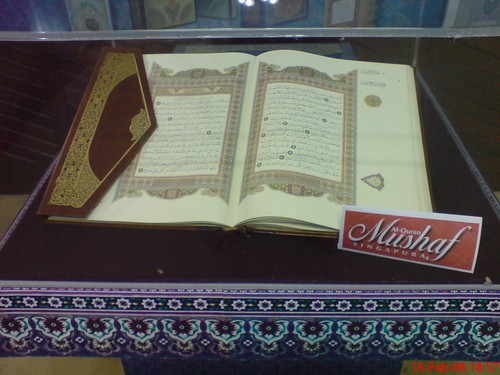
The Singapore Quran


The mushaf Singapura is on display at Masjid Kampong Siglap, the Darul Quran Centre of Singapore.
A few years ago I went to Shah Alam, where there is a Centre for Quran Calligraphy, called Yayasan Restu. It was the most wonderful place in Malaysia I have ever been to. Apparently it began because one day the former PM of Malaysia, Dr M, was in another Muslim country and he discovered that except for a few very old fogies, nobody is left with the discipline of writing Qurans anymore, especially since printing has become more feasible. Also, he was perturbed that the Saudi mushaf had become ubiquitous in the Muslim world, and that it was becoming mistaken for THE mushaf Uthmani (which to my surprise and consternation, a great majority of Muslims I know believe to be true). So he came back to Malaysia and ordered that, as the Melayu boleh apa-apa saja, his countrymen will reclaim this almost-lost art of calligraphy and Quran manuscript.
So they embarked on the exercise of designing and writing the mushaf Malaysia. The thought and spirituality that went into the exercise was so inspiring - they really took it to heart that this is the Divine Word and had to be treated with utmost reverence and thought at every step.
They used only natural dyes from nature, like different types of wood and spices, to mix into ink, so as not to use artificial chemicals to write, as they believed that to write the word of God it is befitting to use products from nature, which we know, glorifies God.
The paper used was of the highest possible quality, and there were commissioned pieces which were made of paper guaranteed to last 700 years!
And the artistic design that went into the decoration of the side margins and symbols - all of them were based on existing artistic motifs found in ancient Malay woodwork or craftsmanship, or using stylised representations of local flowers. Beautiful.
Then came the actual khat - calligraphy - itself. They set out to use the Jawi style of writing, with large, circular strokes with a natural reed stick pen. There was a team of writers just writing away page after page, dipping their reed pen into natural ink.
The whole thing was beautiful. I could never look at the mushaf Madinah the same anymore. Somehow the barakah was with the Malaysian one. Not to mention the Malaysian one contains bright colours instead of sombre dark green and beige.
I bought several of the mushaf Malaysia, and my sons, who are undergoing the tahfiz programme, prefer it to the Madinah version, for some reason.
I myself prefer it because it is bright and good to the eye, and gives off the impression of nur.
When Shaykh Abdul Hakim Murad came to Singapore the previous time, he talked excitedly about 2 things in Malaysia - ISTAC and this place.
I can understand why. Now it seems that we have commissioned them to design a mushaf Singapura. I think it is a great idea.

Sunday, February 24, 2008

Ambigrams


I stumbled upon Ambigrams, a blog by a Singaporean couple, which I find fascinating.

They take orders too.

Tuesday, February 19, 2008

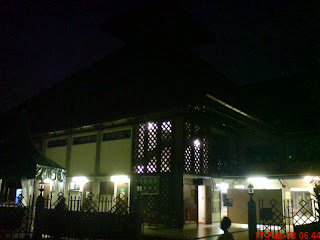
Masjid Darul Aman on Sunday Subuh

1212
Last Sunday the Mudpie family tried out subuh at Masjid Darul Aman (the mosque you see next to Eunos MRT). It was a small number of people who truned up, and there was no kuliah subuh. After the prayers, we left for Mc Donald's.


Sunday, February 17, 2008

Excerpt : Three Cups of Tea

It was the most humbling thing I had ever seen. Haji Ali had just handed over half the wealth of the village to that crook [as a bribe to allow the construction of a school for both boys and girls], but he was smiling like he'd just won the lottery.
Haji Ali paused before the building everyone in the village had worked so hard to raise. It held its ground firmly before Korphe K2, with snugly built stone walls, plastered and painted yellow, and thick wooden doors to beat back the weather. Never again would Korphe's children kneel over their lessons on frozen ground.
"Don't be sad," he told the shattered crowd. "Long after all those rams are dead and eaten this school will stand. Haji Mehdi [the corrupt politician who had extorted the bribe from them] has food today. Now our children have education forever."
After dark, by the light of the fire that smouldered in his balti [hut], Haji Ali beckoned Mortenson to sit beside him. He picked up his dog-eared, grease-spotted Koran and held it before the flames. "Do you see how beautiful this Koran is?" Haji Ali asked.
"Yes."
"I can't read it," he said. "I can't read anything. This is the greatest sadness in my life. I'll do anything so the children of my village never have to know this feeling. I'll pay any price so they have the education they deserve."
"Sitting there beside him," Mortensen says, "I realised that everything, all the difficulties I'd gone through, from the time I'd promised to build the school, through the long struggle to complete it, was nothing compared to the sacrifices he was prepared to make for his people. Here was an illiterate man, who'd hardly even left his little village in the Karakoram," Mortenson says. "Yet he was the wisest man I've ever met."

Education and learning. Muslims always proclaim that our Master the Prophet of God, may God bless him and give Him peace, stated that the pursuit of knowledge is a duty for every Muslim, male and female, from cradle to grave.
Yet, all the greatest centres of learning are not in Muslim lands. None of the universities in the Muslim world make it to the list of the top 100 in the world. Virtually none of the thousands of technological inventions patented each day today come from Muslim minds. A recent report by the UN showed that the Muslim world has the largest proportion of illiteracy compared to anywhere else, and it is growing. It also has the greatest extreme of wealth in the world.

It is said that we must seek knowledge even if it be in China. In China, the old man knowledge has turned to stone waiting for us.

The irony is that we are Muslims in an affluent country who are blessed with the opportunity and responsibility of learning which we do not pursue, whilst there are millions of Muslims yearning to learn, but do not have a glimmer of opportunity.

Suggested Blog : Darwisiy

I stumbled upon this blog by a Malaysian sister. It is soulful and visually attractive, obviously taking a lot of effort from her. She has a Malay blog, which is equally beautiful.
I pray God give her comfort and strength to continue her work, spreading His beauty to the world.

Saturday, February 16, 2008

Late : The Importance of Reunion Dinners

I should have posted this earlier, sorry. This is meant for Chinese New Year, but it applies for all of us, I guess.
Family is the only personalised gift from God.
Treasure it. I am glad that we Singaporean Malays still put in what sometimes seems to be jihadian efforts to meet all our kith and kin for Hari Raya.
It is sad that many of the Chinese are starting to look at their reunion dinners as a bother and prefer to spend the time on vacation.
I pray we never have that happen to us.

Petronas Chinese New Year Ad.

World's 'oldest' person is a Muslim lady in Israel


This was on the BBC website today.

Excerpts :

According to Mrs Amash, she was born 120 years ago - a claim, if confirmed, that would make her the oldest person in the world.

Mrs Amash, of Bedouin descent, says that the secret to her longevity is a healthy diet - she eats lots of vegetables.

A devout Muslim, Mrs Amash has made five pilgrimages to Mecca, the last trip in 1990, relatives say.

For her part, Mrs Amash has one piece of cautionary advice for younger generations.

"They drink too much Arak (an Arabic alcoholic drink)," she says.


In Pakistan, Islam Needs Democracy

Here is an op-ed article in the New York Times today.

Excerpts -

This may come as a surprise to Americans, but the Wahhabist religion professed by the militants is more foreign to most Pakistanis than Karachi’s 21 KFCs. This is true even of the tribal North-West Frontier Province — after all, a 23-foot-tall Buddha that was severely damaged last fall by the Taliban there had stood serenely for a thousand years amid an orthodox Muslim population.

Last month I was in the village of Pakpattan observing the commemoration of the death of a Muslim Sufi saint from the Punjab — a feast of dance, poetry, music and prayer attended by more than a million people. Religious life in Pakistan has traditionally been synonymous with the gentle spirituality of Sufi mysticism, the traditional pluralistic core of Islam. Even in remote rural areas, spiritual life centers not on doctrinaire seminaries but Sufi shrines; recreation revolves around ostentatious wedding parties and Hollywood, Bollywood and the latter’s Urdu counterpart, Lollywood.


The big problem — as verified by a poll released last month by the United States Institute of Peace — is that while the Pakistani public condemns Talibanism, it is also opposed to the way the war on terrorism has been waged in Pakistan. People are horrified by the thousands of civilian and military casualties and the militants’ retaliatory attacks in major cities. Despite promises, very little money is going toward development, education and other public services in the frontier region’s hot zones. This has led to the belief that this war is for “Busharraf” rather than the Pakistani people.

Last Supper at Masjid al Abdul Razak


Masjid al Abdul Razak
Originally uploaded by LilMudPie
Last night Mrs Mudpie and I went to Masjid al Abdul Razak for its closing talk.

The mosque is now closed for 9 months for renovation.

The ustaz spoke about why we should be grateful for the mosques that we have in Singapore, how in God's wisdom and grace, our forefathers bequeathed numerous plots of property to build mosques and madrasahs.
It is the wisdom of God because in today's context of land ownership in Singapore where the majority of Singaporeans do not own private property that is capable of being bequeathed, we inherit from our forefathers such property already.

He spoke about the spiritual significance of waqaf (bequests).
Our Master the Prophet, God bless Him and grant Him peace, had taught that when a son of Adam dies, all his actions cease, and he does not earn any more sin or merit until the day he is raised in Judgment, except for three things - perpetuated goodness (amal jariah), knowledge that is useful and the prayers by a good child.
The easiest is the first, and the most difficult is the last.

Ustaz spoke that we should not be influenced by those who gripe at having to contribute to the mosque building fund, they are instigated by shaitan, he says.
The reality is that we must not see charity as something that makes us poorer. We are promised that zakat, and therefore charity, will not make one poor. And even if we do part with money, we must think of it not as a total write off, but as an investment in the future (or as Mrs MudPie would call it, the "real" future) which is the Hereafter.

In this regard, ustaz spoke about how there is no monasticism in Islam, that our Master, God bless Him and grant Him peace, had said so. We should work and earn money and acquire property, but that is not the end objective. Money and worldly success is a means or instrument to success in the Hereafter. We should look to ways to make more money so that we are able to give more in charity or bequests for the benefit of others. Ustaz mentioned that our Master had said that poverty is the root cause of disbelief, and how we can see this is true in some countries where other religions entice Muslims away from faith succeed because their victims are so mired in poverty. I have myself seen cases where Muslims have declared that they could go to a church and get money whereas MUIS and mosques do not, so they will go to the church. May God forgive them, for they do not realise what they do. (My personal position when I encountered such persons was to feel sorry for the church that they will be going to, because that church will be straddled with such an unreasonable and mercenary person, who would not be a true believer of Jesus anyway, but of "Jesus dollars").

Ustaz said that the government has just announced a few schemes where we set aside some of our CPF money and it comes back to us when we are old and jobless, this is the same, except it comes to us in the Hereafter.
Ustaz also said that because of the nature of land ownership in Singapore, we are blessed to have an agency like MUIS to manage our bequests. He says not to listen to people who criticise, because we just need to look at other Muslim countries where there are many bequests made by good people which are neglected after their deaths.
He says this is very sad, because the intention of the bequestor to perform amal that continues after his/her death is neglected by the community.
Praise God, that in Singapore, because land is so scarce and precious, great care and effort is taken by MUIS to maximise every square inch of land that is bequeathed.

A more interesting note made by Ustaz is that although the vast majority of people in Singapore cannot own land that they are able to bequeath, the wisdom and grace of God (Glorious and Exalted is He) has given most Singaporean Muslims the opportunity to bequeath by way of the Mosque Building Fund contributions. Through this we all are able to perform amal jariah.

After the talk, I was surprised (pleasantly, of course) that there was briyani- and Alaudin's briyani at that. May God bless the people who paid for it.

By the way, the mosque still needs $700,000 to complete its renovation. Please pass the word around.

Thursday, February 14, 2008

My Saudi Valentine

Published: February 13, 2008


TOMORROW will be my second Valentine’s Day in the United States. As I’ve discovered, the celebration here bears little resemblance to the one I know from growing up in Saudi Arabia.

Yes, there are dates. But in Saudi Arabia, we eat them. As for the other kind of dating — the kind that will fill restaurants here tomorrow night — don’t count on it.

Read the article here.

Wednesday, February 13, 2008

WardahBooks' Best Read 2007


Well, this is a good initiative.

Wardah gives its thumbs up for the best read of the year to Syed Hossein Nasr's "The Garden of Truth".


Personally, I am not a big fan of Syed Hossein Nasr, his writing style is not sufficiently contemporary to be man-in-the-street popular, and his position is, to me, based on his previous books, somewhat rarified, if not occasionally pompous.
However, I must confess I have not read this latest book, so maybe it will be a change.
Come to think of it, Sufism in English is invariably packaged in intellectual terms, and employs formal, university language.
This adds to an exclusivity, or snobbery, that is inconsistent with the whole idea of Sufism, in that it is a phenomenon of the heart more than the mind. But I digress.


I've just read Three Cups of Tea : One Man's Mission to Promote Peace ... One School at a Time.
A highly inspirational book that makes you wish you could just take off and build schools for poor village children in remote places.
And also to renew faith that all is not lost up there in Afghanistan and Pakistan.
Bought it at Popular and read it all in one day the next day, on the train to work, during lunch, on the train back from work.

I'm too lazy to write a book review, so here is someone else's.

From Publishers Weekly

Starred Review. Some failures lead to phenomenal successes, and this American nurse's unsuccessful attempt to climb K2, the world's second tallest mountain, is one of them. Dangerously ill when he finished his climb in 1993, Mortenson was sheltered for seven weeks by the small Pakistani village of Korphe; in return, he promised to build the impoverished town's first school, a project that grew into the Central Asia Institute, which has since constructed more than 50 schools across rural Pakistan and Afghanistan.
Coauthor Relin recounts Mortenson's efforts in fascinating detail, presenting compelling portraits of the village elders, con artists, philanthropists, mujahideen, Taliban officials, ambitious school girls and upright Muslims Mortenson met along the way.
As the book moves into the post-9/11 world, Mortenson and Relin argue that the United States must fight Islamic extremism in the region through collaborative efforts to alleviate poverty and improve access to education, especially for girls. Captivating and suspenseful, with engrossing accounts of both hostilities and unlikely friendships, this book will win many readers' hearts. (Mar.)
Copyright © Reed Business Information, a division of Reed Elsevier Inc.
All rights reserved. -

Masjid al-Abrar


Masjid al-Abrar
Originally uploaded by LilMudPie
Masjid al-Abrar is one of the oldest mosques in Singapore, built in 1820s.
Not known to most people, when this mosque was built, it was facing the sea. Years later, the shore in front of it was reclaimed, so the mosque "moved" inland. When it was first built, it was a landmark for ships coming into Singapore harbour as one of the few relatively large buildings.
The mosque was built by Tamil settlers, who called it kuchu pillay, or small temple. It was actually very much smaller than what it is now. If you visit this mosque today you will enter walk up a few steps through a large door, which was actually the gate. Inside this gate are a few more steps and then there is a chamber. If you look carefully, you will realise that this chamber, which would easily be mistaken for the prayer hall, was at one time a separate building by itself - it was actually the hut that was the original mosque.
The mosque is always overfilled on Fridays for jumaat, with worshippers on the sidewalk, and sometimes on the road space.
The khutbah is in Tamil (correction : Arabic), and is very very short. There is a kuliah before azan in Tamil, and then the khutbah Jumaat is just the short part that we always hear in arabic at the end of other khutbahs.
The mosque has a prayer hall for women on the upper level, accessible by the door on the right. Due to space constraints, there is not enough room for women during Jumaat prayers.
There is a very popular Malay restaurant opposite this mosque called Nusantara.

Monday, February 11, 2008

Sunday, February 10, 2008

Videos of Habib Umar

Habib at Masjid Abdul Aleem Siddique -


Here is an intro to the Habib from his visit to London in 2006 -

Habib Umar at Masid al-Istighfar


Masjid al-Istighfar
Originally uploaded by LilMudPie
On Friday night Habib Umar was at Masjid al-Istighfar after magrib prayers.
There was a joyful maulud celebration, after which Habib gave a talk.
The topic he was given was Ummah Cemerlang (Excellent Ummah), obviously a reference to our standard progressive Islam message that we have been getting every Friday.
Habib had a spiritual aspect to all this, as is his principle.
He said sometimes it is said that the ummah has to achieve success by mastering politics, economics, wealth and power.
Habib said this is not correct, because wealth and power belong only to Allah.
How we achieve success is by excellence in our akhlaq (ethics and manners), and all the others will be given by Allah.
He cited how the successful forefathers of ours did not have wealth or power, but had the best of akhlaq, and because they had that one thing, Allah opened up the world to them.
The best example is of course our Master Rasulullah, who did not have wealth or power, but all he had was perfection of character.
Habib described how our Master showed the best of behaviour not only to his family and to the believers, but to the unbelievers and to his enemies as well.
Once Abu Jahal had dug a pit trap to snare our beloved Master.
However, it was God's will that Abu Jahal would fall into the trap himself by accident.
It was also by God's will that by coincidence, our beloved Master the Prophet of God came by and saw Abu Jahal suffering in the trap, and rescued him from it, in spite of knowing that the trap had been intended for him.
Rescue your enemy? Can we fathom the depth of compassion of the Prophet?
We all know that we are commanded in the Qur'an to reciprocate evil with good, but how often have you heard that being taught to you nowadays?
Habib mentioned how the mu'min is someone (according to a famous hadith from our Master the Prophet of God) from whose hand everyone else is safe from harm. Least of all a believer will hurt his own friend or family, women or children (I think everyone in the audience immediately thought of the news in the papers of al Qaeda's child suicide bombers).
We live in depraved times. We wallow so deeply in the squalor of our depravity that we have lost all sense of goodness and kindness.
It takes someone from outside the usual noise and clamour of the media and politics to tell us what is important ... again.
Habib made me reallise how wrong the path has been that I have taken, for the path well-trodden leads not always to paradise, but to perdition.
Al-Istighfar. How appropriate is the name of the mosque.
God forgive us all.

Masjid Kasim


Masjid Kasim
Originally uploaded by LilMudPie
The Mudpie family went to Masjid Kasim for subuh this morning.

There was no kuliah after the prayers, so we left whilst it was still dark and I could not get a good external picture.

Only 2 women joined the congregation, and there were 3 rows of men, of whom most were Bangladeshis who huddled into an usrah immediately afterwards.

And no, we did not have our breakfast at the coffee shops nearby.

Saturday, February 09, 2008

Minarets - Arrows Pointing to Heaven


Masjid Sultan 2
Originally uploaded by LilMudPie
I have been thinking about minarets lately for some reason. It struck me at Masjid al-Istighfar at Pasir Ris there is a very tall minaret, which is purely decorative and does not serve any function. Ask most Muslims and they would surmise that the reason we still have minarets in mosques today is in order to identify them as such. That is why many people took issue with the minaretless design of some new mosques.

"Minaret" comes from the Arabic word for lighthouse. In some of the oldest mosques, such as the Great Mosque of Damascus, minarets originally served as watchtowers illuminated by torches (hence the derivation of the word from the Arabic nur, meaning "light").

To me, minarets serve the purpose of creating the visual impression of verticality, which is inherent in religious spirituality. When one approaches a building such the the Sultan Mosque (pictured) and sees all the "arrows" pointing up to the heavens, one cannot help but remember the Heavenly. Also, the large, imposing domes inside mosques serve the purpose of creating a focus on the ceiling of something large, spacious and encompassing above the small, cramped individual on the floor.

I had been reflecting quite a bit on buildings and spirituality for some time. When I went to London and Paris and went to the buildings built during the Christian era, I cannot help but be impressed by the spirituality that went into the design of these buildings. For example, even during the height of the Industrial Revolution, spritually inspired architects built gigantic monumental buildings that were the technological marvels of their day, but often deliberately left a row of unpolished and rough foundation stones so as to remind Man that the Almighty is the greatest builder and they are not out to compete with Him.

In Paris, my wife was overwhelmed by the beauty of the Church of the Sacred Heart and the Mosquee du Paris. She asked why dont we get buildings like this back at home?

Maybe our architects and engineers, so used to designing for function, have forgotten that religious building have a spiritual function besides the ritual function. Masjid al-Nahdah is a typical example of this. The mosque, I am sad to say, does not inspire me spiritually. There is something about Masjid Sultan which does. As does Masjid Abdul Aleem Siddique.

Habib Umar at Subuh


DSC00196
Originally uploaded by LilMudPie
Habib gave a talk after subuh prayers at Masjid Abdul Razak this morning.

He spoke about the 7 levels of the nafs.

I wonder if I will ever get beyond level 1? May Allah help me and give me light.

Friday, February 08, 2008

Habib Umar at Baalwie


DSC00190
Originally uploaded by LilMudPie
Here's a snap I took of Habib Umar last night at Masjid Baalwie.

Habib spoke about character (ahlaq). He spoke about one of Habib Hasan's forefathers back in the Yemen. Story is that once he was blessed with a son. His students heard the news and were going to visit him and congratulate him, being a great cleric that he was. On the way, they bumped into a farmer who asked where they were going, and they told him. The farmer asked them what the big deal was, they should instead congratulate him because his donkey had just given birth to a calf, and that was more important. The students were angered at the comparison between their beloved teacher and a donkey, but kept silent and went on to see the habib. When told of the incident, the habib immediately told his students that to the farmer, a new donkey is more important than his having a newborn son. He gathered his students together and hurried to the farmer's residence with gifts, and congratulated the farmer on his new donkey.

On another occasion, as he walked in the streets in his clean clothes, someone who was sweeping a roof threw ashes and soot off and it fell on him. His students were shocked and angered, but the habib's response was to thank God the ashes were already burnt out, or he could have got burnt.

I have been thinking for some time how to apply this sort of thinking in my life, but as if to prove my spiritual poverty, I just cannot do so. May Allah help and guide me to be able to always see the blessings in trials.

Greek Masterpieces


DSC00232
Originally uploaded by LilMudPie
After briyani at Masjid Abdul Razak for Jumaat, the Mudpie family went to the Singapore History Museum to see the visiting Greek Masterpieces exhibition from the Louvre. It was the first time my wife and kids had been to the newly refurbished museum,l and Mrs MudPie immediately said she was reminded of London.

The Greek Masterpiece Exhibition was great. Best of all, it was free entry for Chinese New Year.

I didnt post up most of the other pictures that I took, naked Greek statues being clothed the way they are, of course.

Thursday, February 07, 2008

Chinese New Year

I had to work half day yesterday afternoon because all the Chinese officers were on halfday for Chinese New Year eve. I always said that on Chinese New Year Eve, Singapore is run by minority race people. The good thing is I presume everyone else thought that we were closed, so nobody came.

However because I was at work for only half a day, I had one day's worth of files to clear, so that made leaving at closing time impossible. It was a bit rushed, as I kept looking at the clock hoping to leave as soon as possible to catch Habib Umar, who was going to be at Masjid Abdul Aleem Siddique at 7 pm.

I only managed to get to the masjid at a quarter past eight. Well, better late than never. Mrs Mudpie and the kids had gone on their own earlier with my father in law in Mrs Mudpie's car, so I couldnt see where they were in the already crowded mosque.

The mosque was expectedly full, and of course, there was the usual perfunctory traipse I had to negotiate through the crowd, and the intermittent wave of recognition every two steps. It is always nice to go to these tassawwuf functions because there are the same faces one sees, which makes it feel comfortable and welcoming, together with new ones, which makes one comforted that there is hope for the world after all.

I was up at 5 this morning, planning to go to Masjid Abdul Razak for the subuh kuliah, but Mrs Mudpie and the kids were to exhausted from returning home late last night, so we did not go. I guess it is better they rest so that tonight we can go to Masjid Baalwie instead.

Singapore was deathly quiet this morning, after last night's Chinese New Year eve dinners. There was an article in the paper this morning about how Masjid an-Nur organised a Chinese New Year eve dinner for some poor Chinese residents in their neighbourhood. Bless them, for I am sure they are going to get nothing but a whack from the wahabis.

A few days ago there was an article in the paper about how a school principal gathered flack for prohibiting the schoolkids from bringing non-halal food items to school because the canteen had gone 100% halal. I think that was a bad move. Now it will just make it more difficult for other places to go halal. What was the school thinking? As a minority, I feel strongly about being given the opportunity to exercise my choices and not be dictated by the choices of other religions, so is this not just the shoe on the other foot? Commonsense will tell you that a non-Muslim would want the right to exercise his choice of eating non-halal food, right? This is really a mentality of not putting oneself in the other's shoes before doing something that affects the other guy.

The same thinking, or lack of thinking would be a more accurate way of putting it, is what happened in the Malaysia temple demolition case that led to the riots recently. The authorities kept insisting that they did the right thing by demolishing a Hindu temple that was squatting one state land. They claim that they had given notice a long time before. They claim they promised to look into giving an alternative site for the temple. Anyone with commonsense will tell you that firstly, the demolition of the temple less than a week before Deepavali was clearly either an act of provocation, of arrogance, or utter insensitivity; and secondly, who would be comforted with a mere promise of an alternative site? Does not commonsense dictate that the new site be given them and a period of relocation be allowed, before any demolition is carried out?

The conclusion that one can draw is either that the Malaysian authorities were absolutely stupid, or that they were provocative. I believe it is probably the latter. It is not a coincidence that the elections are around the corner, and there is the opportunity to remove the old to make way for the new. Anyone can see that the whole exercise was initiated by BN (who controls the city council that demolished the temple) factions to oust Malaysia's Chief Indian, Samy Vellu. It is also not a coincidence that soon after there was the hidden camera scandal that led to the ousting of one of Malaysia's Chief Chinese. The only one left is now Malaysia's Chief Malay - and, well Dr M and Anuar Ibrahim have been doing that very well.

Islamic state? Where?

Sunday, February 03, 2008

Masjid AlKaff Kampong Melayu


Masjid AlKaff Kampong Melayu
Originally uploaded by LilMudPie
This morning the MudPie family went for subuh at Masjid AlKaff Kampong Melayu at Kaki Bukit. It was good, alhamdulillah, there were 3 full rows in the men's section. The kuliah subuh was about (again) the quality of our 'ulama today, and also about how we should be economical with talking. Careless and unnecessary speech is bad for the spirit.

Saturday, February 02, 2008

Masjid al-Istighfar


Masjid al-Istighfar
Originally uploaded by
LilMudPie
Last Sunday the Mudpie family went for subuh (dawn) prayer at Masjid al-Istighfar, located at Pasir Ris.

The kuliah subuh was by an eloquent speaker, obviously traditional and Indonesian trained. He spoke about the status of 'ulama - how they are the heirs to the prophets. He mentioned that they are in maqam the same as the prophets of Bani Israil to us, that is, they are our guides and leaders second only to Syiddina Rasulullah.

He spoke about the challenges of life today. He said that although our religious leaders have taken the decision to permit Muslim girls to attend government schools without wearing hijab, it is a decision made at leadership level, and we, as followers, cannot read any more into it by saying it is all right to dispense with hijab altogether.

He made the point that this does not mean it is all right to dispense with hijab outside of school. This had been emphasised by our mufti. So, he said, whether or not one agrees with the decision made by our religious leadership, we have to accept, for they are our 'ulama, and they will bear the responsibility before Allah for it. However, our 'ulama are not responsible for what happens outside school if a Muslim schoolgirl does not wear hijab. Her parents are, and they cannot say that because the hijab had been dispensed with in school, it is dispensed with elsewhere as well. He cautioned parents to be wary of this sort of thinking, as the pressure on young people today to lead a certain lifestyle today is overwhelming. He says that the young people today, and not just for Muslims, are encouraged to lead lives of immodesty, sex, drinking and materialism, so we must not take things lightly.

He advised parents to be kind and close to their children. If we are not close to them, they will become close to their friends, and often we do not know what these friends are like. He pointed out there were no young people in the mosque there, only old people come to the mosque for subuh.

I am thinking of videotaping and uploading to this blog these sermons that I go to.

Hmmmm.

Monday, January 21, 2008

Pork Sausages Galore


Chinese New Year is coming, and Chinatown is gearing up for it.

I walked through a Chinatown street just now to get to the subway from my office, and walked gingerly past a long row of pork sausage stalls trying to avoid contact. Yes, it is in the air .... the war between pigs and the Chinese.

Muslims had just commemorated their new year, and it is based on the lunar month calendar system. The Chinese have a combined lunar-solar calendar.

For convenience, here are the dates of the Chinese festivals coming up (from wikipedia) -

Holidays

The Chinese calendar year has nine main festivals, seven determined by the lunisolar calendar, and two derived from the solar agricultural calendar. (Farmers actually used a solar calendar, and its twenty-four terms, to determine when to plant crops, due to the inaccuracy of the lunisolar traditional calendar. However, the traditional calendar has also come to be known as the agricultural calendar.) The two special holidays are the Qingming Festival and the Winter Solstice Festival, falling upon the respective solar terms, at ecliptic longitudes of 15° and 270°, respectively. As for all other calendrical calculations, the calculations use civil time in China, UTC+8.

Date English Name Chinese Name Remarks 2008


month 1
day 1
Chinese New Year (Spring Festival) 春節
chūnjié
Family gathering and festivities for 3–15 days Feb 7


month 1
day 15
Lantern Festival 元宵節
yuánxiāojié
Yuanxiao eating
and lanterns
Feb 21


Apr 4
or 5
Qingming Festival (Clear and Bright) 清明節
qīngmíngjié
Tomb sweeping Apr 4


month 5
day 5
Dragon Boat Festival 端午節
duānwǔjié
Dragon boat racing
and zongzi eating
Jun 8


month 7
day 7
Night of Sevens 七夕
qīxī
For lovers, like Valentine's Day Aug 7


month 8
day 15
Mid-Autumn Festival (Moon Festival)[1] 中秋節
zhōngqiūjié
Family gathering and moon cake eating Sep 14


month 9
day 9
Double Ninth Festival (Double Yang) 重陽節
chóngyángjié
Mountain climbing
and flower shows
Oct 7


month 10
day 15
Xia Yuan Festival 下元節
xiàyuánjié
Pray for a peaceful year to the Water God Nov 12


Dec 21 or 22 Winter Solstice Festival 冬至
dōngzhì
Family gathering Dec 21


month 12
day 23
Kitchen God Festival

Jan 18


Point to note - the Lantern Festival mentioned above is not the same as the one celebrated in Singapore, which is known as the Mid-Autumn Festival in China. The Chinese in Singapore do not observe the Lantern Festival mentioned above.

Tomorrow is Thaipusam. I have not seen one of those in a long time. When I was in secondary school, my school was located at Serangoon Road, and the whole region would be congested with kavadi carriers and their supporters. It was an experience, really.

This reminds me of why I love being in Singapore. So many cultures, so many faiths, and nobody bugs you about yours.

Alhamdulillah.

Sunday, January 20, 2008

Inspirations : Sir Ahmed Hassanein


I was reading about Sir Edmund Hilary and was reflecting about what a truly inspirational man he was. When I was a child, everyone knew "Sir Edmund Hilary who climbed Mount Everest with Tensing Norgay".

In reasearching on Sir Edmund on the net, I found another adventurer, albeit of a different nature, in the form of Sir Ahmed Hassanein. Here is the short description of him in Wikipedia -

"Ahmed Pasha Hassanein (1889 - 1946) - Egyptian explorer, diplomat, one of two non-European winners of Gold Medal of Royal Geographical Society in 1924, King's chamberlain, fencing participant to 1924 Olympics, photographer, author and discoverer of Jebel Uweinat, and writer of "The Lost Oases" book in three languages."

It was interesting enough, but when I read the details, I was immediately enraptured by this man. Son of a sheikh of al-Azhar, but graduate from Oxford? Explored the then unexplored Sahara desert and discovered evidence of civilisation even earlier than the pyramid-builders, from a time when the Sahara was fertile?

Interesting description of him -
"... explains Rennell Rodd’s remarks in his introduction, where he says that Hassanein had consulted him ‘in a very delicate matter’ in which he proved himself to be ‘generous in his judgements and, for I know no other way of expressing what I mean, a great gentleman’. Rosita had fallen in love with Hassanein, but the details are hidden behind Hassanein’s discretion and Rosita’s catty remarks. It was said in Cairo that she would climb into his tent and try to seduce him, but that Hassanein refused her. ‘I was determined not to offend Allah and his mercy’, Hassanein is remembered to have said, ‘for we were in the midst of uncharted desert with the perils of death surrounding us on all sides.’".

Read the rest in Wikipedia.

Masjid Darul Gufran This Morning


This morning the whole Mudpie family went for subuh prayer at our neighbourhood mosque, Masjid Darul Gufran at Tampines.

The imam was a young man, a graduate from the Natuonal University of Malaysia, and alumni of Madrasah Aljunied here. I know him because he did a stint of internship at my office a few years ago whilst still in university.

He gave the customary kuliah subuh (dawn talk) that mosques have on Sundays, and it was on how he read in the Readers' Digest about the health benefits of rising early, and also about how we should be wary of our words. He quoted Imam al-Gazzali who said that words can be sharper than swords. He cautioned us not to be carried away with speech trends, that just because some young people nowadays are freely using certain expressions today, we must remember that we are in an Asian setting, where language is not merely meant for function, but indicates a person's character as well.

He recounted how when he went to Malaysia, some of his colleagues chided him for using "aku" ("I") and "kau" ("you"), even though these pronouns are commonly used here and now. He was advised that these terms were disrespectful and used to insult the other person.

How interesting. I was always taught not to use those terms as they are rude. I felt some discomfort when I read a short novel in the Malay newspaper which used these terms. I guess their use has become prevalent her nowadays because our people think first in English and translate into Malay, so "I" becomes "aku" and "you" becomes "awak".

Also, I remember when I was a child people always referred to Rasulullah s.a.w. as "Baginda" ("His Majesty") and never as "Rasulullah" or "Nabi". In Malay, certain words are used for royalty only, and these can be used to Rasulullah. Some words are reserved only for Him, such as we are never supposed to use the word "mati" for His death, but "wafat" instead; and not "kata" for "said", but "sabda".

As you must have noticed, I have decided to use a capital letter to start to refer to Him. I guess this is the least I could do.


Saturday, January 19, 2008

Excited : Something to look forward to


I am so excited. I stumbled on this on amazon.com. It is coming soon, insha Allah. By the way, here's the only picture I have ever seen of the man.

The Shaykh le Gai Eaton gave a speech at the Radical Middle Way.

Here's the podcast.

Here is a nice example of his writing, for the uninitiated, and another.

Crossroad check : Ashura, Judaism, Madinah and The Prophet

An interesting article examines the question : What was the Jewish festival that our Master was referring to which he saw them observing in Madinah that we now know of as Ashura?

Thursday, January 17, 2008

Masjid Jamae Chulia at South Bridge Road


Masjid Jamae Chulia
Originally uploaded by LilMudPie
I've been going to this mosque for daily prayers as well as for Friday prayers as it is the nearest to my office. It is all in Tamil, which I dont understand a word of. It is a very old mosque, built by the very first generation of immigrants, and stands right next to a famous Hindu temple. This mosque is the centre for Tamil Muslim culture and learning in Singapore. Although located along a very busy street, the walls prevent the noise from coming into the mosque itself, so it is quite serene inside. A little dilapidated, and needs to be more woman-friendly, in my view. Lots of tourists come in to see what a mosque looks like. I guess for many of them it would be the first contact with Islam.

DVD Review : The Willow Tree

I borrowed this DVD, something I just had to do, being a lifelong movie fan and a Muslim who looks for spiritual learning points in every film.

Majid Majidi is the director of this delightful Iranian film. This is his latest, and came out last year. The story is about a blind person named Yusuf gaining his sight in answer to his prayers.

This is Majidi's most overtly religious of all his films. Yusuf is a blind professor of Persian literature, and his specialty is Rumi. In spite of his blindness he is a successful professor, a husband and father. He prays for God to give him sight as he had always been grateful for what he has been given.

The moral of the story is be careful what you pray for, and be grateful for what you are not given.

Gaining sight was ecstatic for Yusuf, presented in the way which only Majidi would. He jumps about like a little child in the hospital. Gradually, after the celebration is over, the challenges that come with eyesight set in. He sees pretty girls for the first time and sees his wife for the first time - she is plain. He sees a pickpocket on the subway. He sees ugliness.

I must confess I do not rate this film as highly as his Children of Heaven and The Colour of Paradise - which, if they were books, would be Sufi manuals by themsleves. I also loved Baran, although less so, but I would rank The Willow Tree to be my least favourite.

Wednesday, January 16, 2008

New School Term Begins


Masjid Darul Gufran
Originally uploaded by LilMudPie
Here's a picture I took last year at the first day at weekend madrasah at Masjid Darul Gufran for Omar. It was cute how the little 7-year olds are learning how to pray in congregation.

Masjid Hj Mohd Salleh at Palmer Road

Here's a snapshot I took of inside Masjid Haji Mohd Salleh at Palmer Road, the one attached to the shrine of Habib Noh, the saint of Singapore. It is a small little hut of a mosque in the middle of the busy city area, but located slightly apart from the skyscrapers so that it remains serene and disconnected. A true oasis it is. When I was working in that area for a few years, I used to love to go there for 'asr prayer and stay on for maghrib before leaving for home. I feel I can leave all the hustle and stress behind me there when I pick up a Qur'an and just read it softly. I always found comfort and strength in this mosque.

Masjid Sultan


Masjid Sultan 4
Originally uploaded by LilMudPie
I was at Masjid Sultan last Sunday, just to pop in for zohor prayer, when I noticed how beautiful it was.

Saturday, January 12, 2008

DVD Review : Kingdom of Heaven


I re-saw Kingdom of Heaven a few days ago.

The first time I saw it was when it was first released on DVD, about a year ago.

I felt it was a disappointment then.

In retrospect, I guess at that time, memories of Gladiator were still too fresh in everyone's minds, and we were all waiting for a bigger and better, more macho and violent, sequel to it.

It did not help that Kingdom was heavily promoted as being by the same director who gave you Gladiator.

When Kingdom did not meet these expectations, I guess we all quickly wrote it off.

There was a beauty of re-watching Kingdom two years later.

This time the ghost of Gladiator is well forgotten, and Kingdom could be judged on its own merits, outside Gladiator's shadow.

Looking at it again, I realised that Kingdom was clearly not meant to be a mere follow up act to Gladiator.

Gladiator was a pure visceral adrenaline rollercoaster ride of a film, meant to engage your guts more than your heart. There was no message there except "rip the guts out of the emperor in the most spectacularly bloody way possible".


Kingdom had its exciting moments, but none anywhere close to Gladiator in spectacle.

However, Kingdom was clearly a film with a message, and the director Ridley Scott (Alien, Blade Runner, Thelma and Louise, Legend, Matchstick Men, A Good Year, Black Hawk Down, American Gangster) was messaging more in this film than any other before.

In the second viewing of Kingdom, I grew to like Orlando Bloom.

Whereas he was everyone's unanimous choice as the reason why the film flopped, I now think he is perfect for the part.

He does not look too European, he is clean cut, and youthful-looking, which stands him out from the rest of the jaded, war-weary souls in Jerusalem.

He looks the perfect hero to negotiate the surrender of Jerusalem - can you imagine a more macho Hollywood actor like Russel Crowe doing something like - surrendering - to Arabs?

Anyway, I liked some of the musings thrown about in the film, which is more noticeable only in a second viewing.

Ed Norton was brilliant even with a mask on -


He exuded beauty of character trapped in deformity of body.

Ed Norton, well, he is just great as an actor to project a commanding presence without showing his face the whole time.

Eva Green (my current hot favourite actress) was clearly the token female character, but she provided a good bridge between the players and provided a little love interest to break the dramatic tension.

I must say that she looked smashing whilst decently dressed, even with hijab. That's another thing in this movie you probably will never see anywhere else.


The British actors were stereotyped as - well - characters speaking with British accents.

One of them is Jeremy Irons (whose voice I will always remember reading the Alchemist in my car CD) and another is the guy who appears in the TV series Heroes as the invisible man. Of course, Liam Neeson too.

The theme of the film is about the pointlessness of war.

The war in Jerusalem was pointlesss then, and it is pointless now.

Balian (Orlando Bloom) asks Salahuddeen "What is Jerusalem?" and the latter answers "Nothing - everything!".

To understand this we must realise that just before than Balilan had threatened to destroy all the holy places in Jerusalem, and that for each Crusader killed, 10 Muslims would be killed, leaving Salahuddeen with no army thereafter.

The reply from Salahuddeen was not what one would expect.

His answer to Balian's threat to destroy the city was "I wonder if it would not be better that you did" - indicating he does not care about the buildings.

And his answer to Balian's threat to kill 10 Muslim soldiers for each Crusader, Salahuddeen's answer was "You have women and children in your city, what about them?".

With Balian clearly left with nothing to negotiate with, Salahuddeen nevertheless offers the Christian safe passage out of Jerusalem.

His victory was not to be only military, but moral as well.

To offer your enemy a gift at the moment when you have defeated him - it reminds me of our Master, the Prophet, himself did at the liberation of Mecca.


There are lessons to all of us in this movie.

Many Muslims are clamouring for defeat of the Israelis and re-conquest of Jerusalem.

However, we forget that Jerusalem had been conquered by the Muslims twice before in history.

First, it was under Syiddina Omar.

There was no blood shed in the city.

The Christians gave the keys to the Church of Holy Sepulchre to him.

Second, when Salahuddeen re-took it from the Crusaders.

Again he negotiated a bloodless surrender.

In neither case did the Muslim side spill blood in Jerusalem.

Now, Jerusalem is the third holiest city in Islam. Like the other two, it should be treated as sacrosanct.

In Makkah and Madinah, it would be unthinkable to spill blood.

However, in Jerusalem now, blood flows like water.

I personally believe that Jerusalem will never be liberated from the Israelis simply because the people defiling it now are the Muslims.

We defile it with the blood of innocents everyday.

Also, we all know that Hamas is Saudi-backed, and the minute they were to take over Jerusalem, they would demolish al-Aqsa mosque and rebuild it in a more "Islamic" form - meaning no more Dome of the Rock, which is actually a shrine to heretical innovation in the eyes of Wahabbism.

The Palestinian people have to wake up and realise that.

The day we treat Baitulmaqdis with reverence is the day that we deserve her, and God will only give us what we deserve, right?

Tuesday, January 08, 2008

Beautiful sunset in kuching


We went to Kuching, Sarawak for a few days in December, right after my nephew's wedding.

It was rainy in Kuching, but it was nice and scenic nevertheless.